


Brushing twice daily is an important part of maintaining oral health. However, it is not enough to clean the spaces between your adjacent teeth. Plaque, food particles and bacteria can accumulate in the tight spaces between teeth and along the gumline as they are inaccessible by a toothbrush. If left undisturbed, this buildup can contribute to cavities, bad breath, gum disease and eventual tooth loss.Thus, the role of traditional floss and water flosser becomes important as they can clean the inaccessible areas.
For decades, traditional floss has been considered the gold standard for cleaning between teeth. In recent years, however, water flossers have gained popularity as a convenient and comfortable alternative.
This article compares water flossers and traditional floss, discussing in detail their types, pros, cons, uses and effectiveness to help you choose the interdental cleaning method that best supports a healthier smile for you.
Why Cleaning Between Teeth Matters?
Healthy teeth are in close and tight contact with each other, that is they have a close interdental contact. These interdental areas are inaccessible to the reach by a toothbrush. If left uncleaned, plaque (sticky film made up of bacteria), food particles, and tartar can keep on accumulating between the teeth and irritate the gums.
Poor interdental cleaning may lead to:
- Cavities between teeth
- Bad breath
- Bleeding gums
- Gum disease
- Bone loss around teeth
- Implant complications
Interdental cleaning once daily significantly reduces plaque buildup and supports long-term oral health.
Water Flosser
What Is a Water Flosser?
A water flosser is an electronic handheld device that sprays a pulsating stream of water between teeth and below the gumline and is used to maintain oral hygiene. The pulsating water helps flush away food debris and bacteria from areas that may be difficult to reach with traditional floss.
It is also known as oral irrigator and more popularly as Waterpik.
Some unique features of water flossers that make them adaptable to several individuals are-
- Adjustable pressure settings
- Multiple cleaning tips
- Rechargeable batteries
- Reservoir for water
- Specialized tips for braces and implants
How Does a Water Flosser Work?
A water flosser consists of the following parts:
- Water reservoir – stores water or diluted mouthwash.
- Pump and motor – create pulsating water pressure.
- Handle and nozzle tip – direct the water stream.
- Pressure control settings – allow adjustment from gentle to strong pressure.
The water flosser creates a pressurized pulsating water stream that works in two ways:
- Removes trapped food particles and loose debris.
- Disturbs bacterial film beneath the gumline and between teeth.
Unlike traditional floss, a water flosser does not physically scrape plaque off the tooth surface, but it effectively reduces bacteria and plaque buildup.
Types of Water Flossers
Three common types of water flossers are available in market-
1. Countertop Water Flossers
- Larger water tank
- Higher pressure range
- Suitable for home use
2. Cordless Water Flossers
- Rechargeable with small reservoir
- Portable and travel-friendly
3. Faucet-Attached Models
- It is connected directly to the tap for inflow of water
- No need for charging
How to Use a Water Flosser?
- Fill the water reservoir with lukewarm water and select the appropriate tip.
- Start with a low-pressure setting..
- Place the tip in your mouth
- Try and aim it at a 90° angle to the gumline.
- Move slowly along the gumline, pausing for 1–2 seconds between teeth.
- Empty and rinse the reservoir after use.
- Use once daily for 1–2 minutes.
Pros of Water Flossers
1. Easier to use, especially people who find string flossing difficult.
2.Provides effective cleaning in patients undergoing Orthodontic treatment for tooth alignment. It can clean around brackets, wires and bands easily.
3. Patients with inflamed or bleeding gums often tolerate water flossers better as they are gentle on sensitive gums.
4. Helpful for Dental Implants patients as cleaning around implants with floss can be challenging.
5. Useful for fixed dental prosthesis like Bridges and Crowns as water jets can reach underneath their margins
6. Beneficial for individuals with reduced hand dexterity. It is a good option for people with:
- Arthritis
- Parkinson's disease
- Stroke-related weakness
- Hand injuries
7. Many patients are more willing to use a water flosser daily because it is quick and comfortable.
Cons of Water Flossers
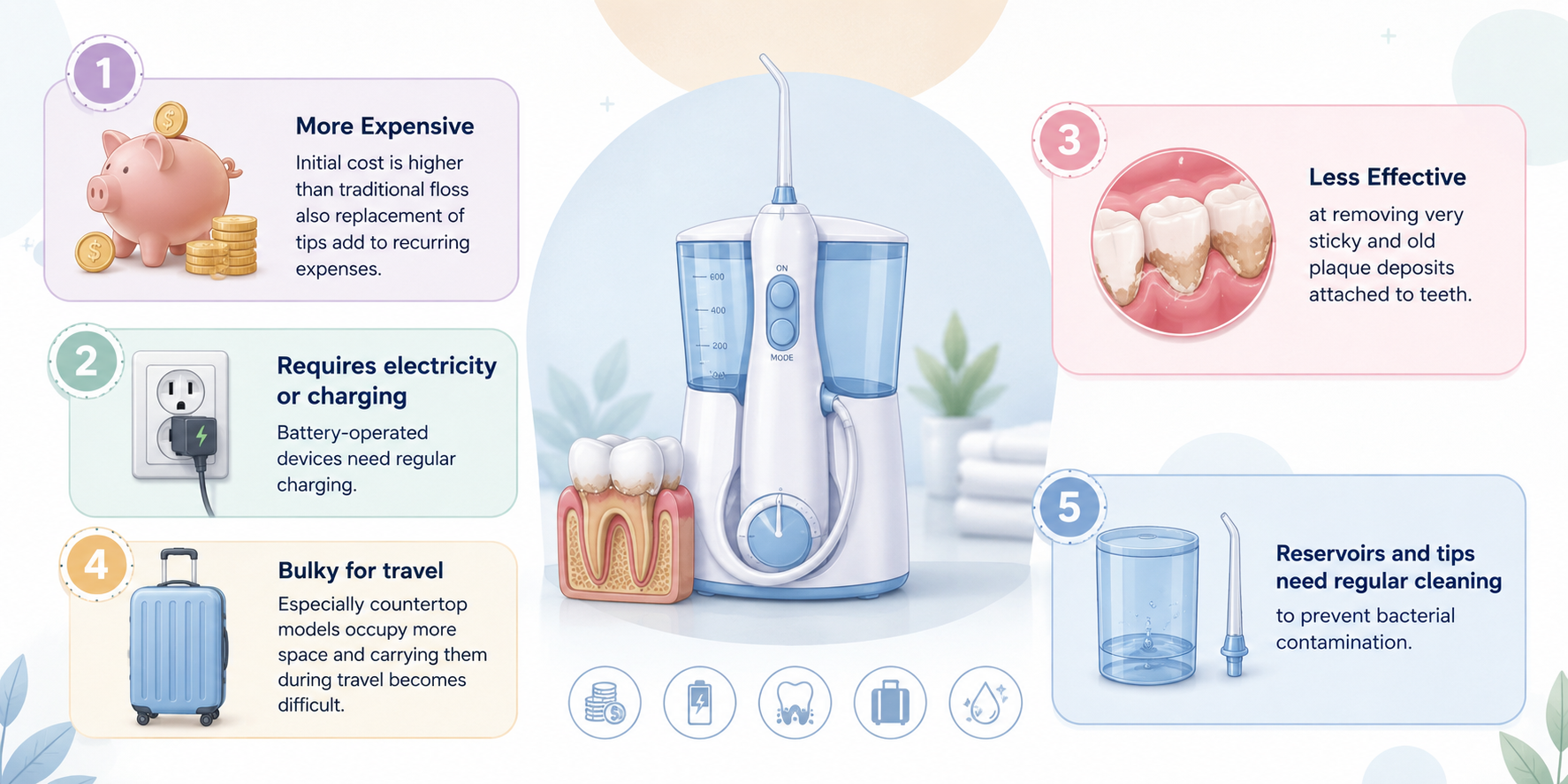
Uses of a Water Flosser
Water flossers can be used for:
- Daily Interdental Cleaning and removing food debris between teeth.
- Reducing Early gum disease:
May help to decrease -
- Gum swelling
- Bleeding
- Mild inflammation
- Reducing Advanced gum disease and cleaning Pockets: Special periodontal tips can deliver water deeper into gum pockets.
- Orthodontic Hygiene : Useful for maintaining cleanliness around braces.
- Implant Maintenance: Helps reduce the risk of infection around implants.
- Freshening Breath: By removing food debris and reducing bacterial accumulation.
Who should use a Water Flosser?
It is useful in patients with:
- Braces
- Dental Implants
- fixed dental prosthesis
- gum disease
- Crowded Teeth
- Elderly Patients
- Arthritis or Limited Hand Function
- Recovering from Oral Surgery
Who Should Not Rely Solely on a Water Flosser?
A water flosser should not completely replace conventional floss in patients who:
- Have very tight contacts between teeth
- Are at high risk of cavities between teeth
- Accumulate heavy plaque deposits
- Have poor brushing habits
In such cases, using both traditional floss and a water flosser often provides the best results.
Traditional Floss
What is Traditional Flossing?
Traditional flossing is the process of using a thin strand of floss to clean the spaces between teeth and beneath the gumline where a toothbrush cannot reach. It remains the gold standard for interdental plaque removal and is recommended by dentists worldwide as part of a daily oral hygiene routine.
How Does Traditional Floss Work?
Traditional floss works through the process of mechanical plaque disruption.
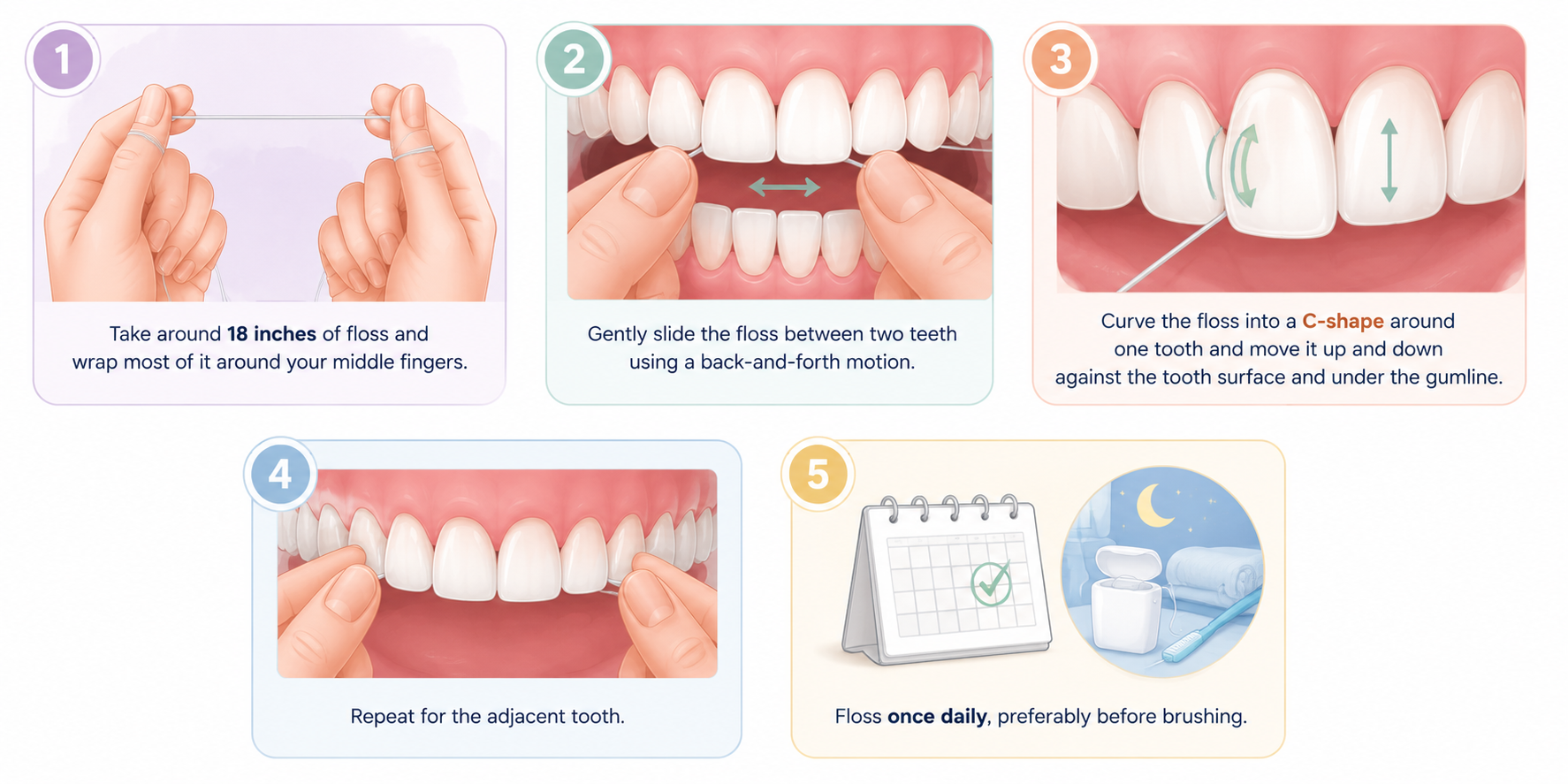
Unlike a water flosser that flushes debris away, floss physically and mechanically scrapes plaque and food particles from the tooth surface. When floss is gently inserted between two teeth and curved into a C-shape around one tooth, it:
- Removes plaque biofilm attached to the tooth surface
- Cleans the area just below the gumline
- Dislodges trapped food particles and thus reduces bacterial accumulation between teeth
Types of Traditional Floss
- Waxed Floss
- Thread is coated with a thin layer of wax hence it slides easily between tight contacts
- Less likely to shred
- Unwaxed Floss
- Thin and slightly rougher
- Provides more friction against plaque
- Dental Tape
- Wider and flatter than regular floss
- Comfortable for people with larger spaces between teeth
- PTFE Floss
- Smooth and shred-resistant , useful in crowded teeth and filled tooth
- Floss Picks
- Short segment of floss mounted on a plastic handle
- Convenient for travel and children
How to Use Traditional Floss?
Pros of Traditional Floss
1. Excellent Plaque Removal
2. Cost-Effective
- Floss is inexpensive and widely available.
- A single roll can last several weeks to months.
3. Portable and Convenient
Floss is lightweight and easy to carry. It requires no batteries, charging, or electricity
4. Effective in teeth with Tight Contacts
Floss can reach narrow spaces where interdental brushes or water flossers may be less effective.
5. Helps Prevent Gum Disease
Regular flossing reduces bacterial buildup and lowers the risk of gum disease.
Cons of Traditional Floss
1. Technique Sensitive
Incorrect flossing may leave plaque behind. Common mistakes include:
- Snapping floss into the gums causing injury
- Using a sawing motion
- Missing back teeth due to lack of space
2. Difficult for Some Patients
Flossing requires good hand coordination and finger dexterity. It may be challenging for people with:
- Arthritis
- Parkinson's disease
- Stroke-related weakness
- Hand injuries
3. Time-Consuming
Flossing each tooth individually may take longer than using a water flosser.
4. Challenging for patients with braces
5. Can Cause Temporary Bleeding
Bleeding may occur in patients with inflamed gums, especially during the first few days of flossing.
Uses of Traditional Floss
- Daily Interdental Cleaning
- Preventing Cavities
- Reducing gum disease
- Maintaining Gum Health
- Cleaning Around Dental Restorations
Who should Use Traditional Floss?
Traditional floss is recommended in patients with:
- Healthy Teeth and Gums
- Tight Contacts Between Teeth
- High Risk of Cavities between teeth
- Mild Gum disease
- Crowded Teeth
- Fixed Crowns and dental fillings
Who Should Not Rely Traditional Floss?
Traditional flossing may not be ideal as the sole cleaning method for patients with:
- Orthodontic braces
- Fixed bridges
- Dental implants
- Severe arthritis
- Parkinson's disease
- Limited hand mobility
- Advanced periodontal disease with large spaces between teeth
Water Flosser vs Traditional Floss
| Feature | Water Flosser | Traditional Floss |
|---|---|---|
| How it works | Uses a pulsating stream of water to flush out food debris and disrupt bacterial film. | Uses a thin strand of floss to physically scrape plaque and debris from tooth surfaces. |
| Plaque removal efficiency | Good at reducing plaque and bacteria but less effective at scraping firmly attached plaque. | Excellent at physically removing plaque from tooth surfaces. |
| Removal of food particles | Excellent | Good |
| Reduction in gum bleeding and inflammation | Excellent | Good, provided it is used correctly and regularly. |
| Ease of use | Easy to learn and use. | Technique-sensitive and requires practice. |
| Time required | Usually 1–2 minutes. | Usually 2–3 minutes. |
| Cost | Moderate to expensive. | Inexpensive and readily available. |
| Portability | Cordless models are portable; countertop models are bulky. | Highly portable and travel-friendly. |
| Need for electricity/charging | Yes | No |
| Maintenance required | Reservoir and tips need regular cleaning. | Minimal maintenance. |
| Risk of gum injury | Low when used at appropriate pressure. | Possible if floss is snapped into the gums. |
| Learning curve | Low. | Moderate to high. |
| Best for | Braces, implants, bridges, gingivitis , and limited dexterity. | Healthy adults, tight contacts, and cavity prevention. |
| Main limitation | Does not physically scrape plaque from tooth surfaces. | Difficult for some patients to use consistently. |
| Dentist's recommendation | Excellent adjunct to brushing and flossing. | Considered the gold standard for interdental plaque removal. |
Water Flossers vs Traditional Floss: Which One Should You Choose?
The best interdental cleaning method is one that fits your oral health needs and that you can use consistently every day.
Both traditional floss and water flossers have unique advantages, and the choice often depends on the dental condition, lifestyle, and manual dexterity.
Choose Traditional Floss If You:
- Have healthy teeth and gums
- Have tight spaces between your teeth
- Are prone to cavities between teeth
- Prefer an inexpensive and travel-friendly option
- Are comfortable using proper flossing techniques
Choose a Water Flosser If You:
- Wear braces or orthodontic appliances
- Have dental implants, bridges, or crowns
- Experience bleeding, tender, or sensitive gums
- Have arthritis, Parkinson's disease, or limited hand mobility
- Find traditional floss difficult or inconvenient to use regularly
What Do Dentists Recommend: Water Flosser vs Traditional Floss ?
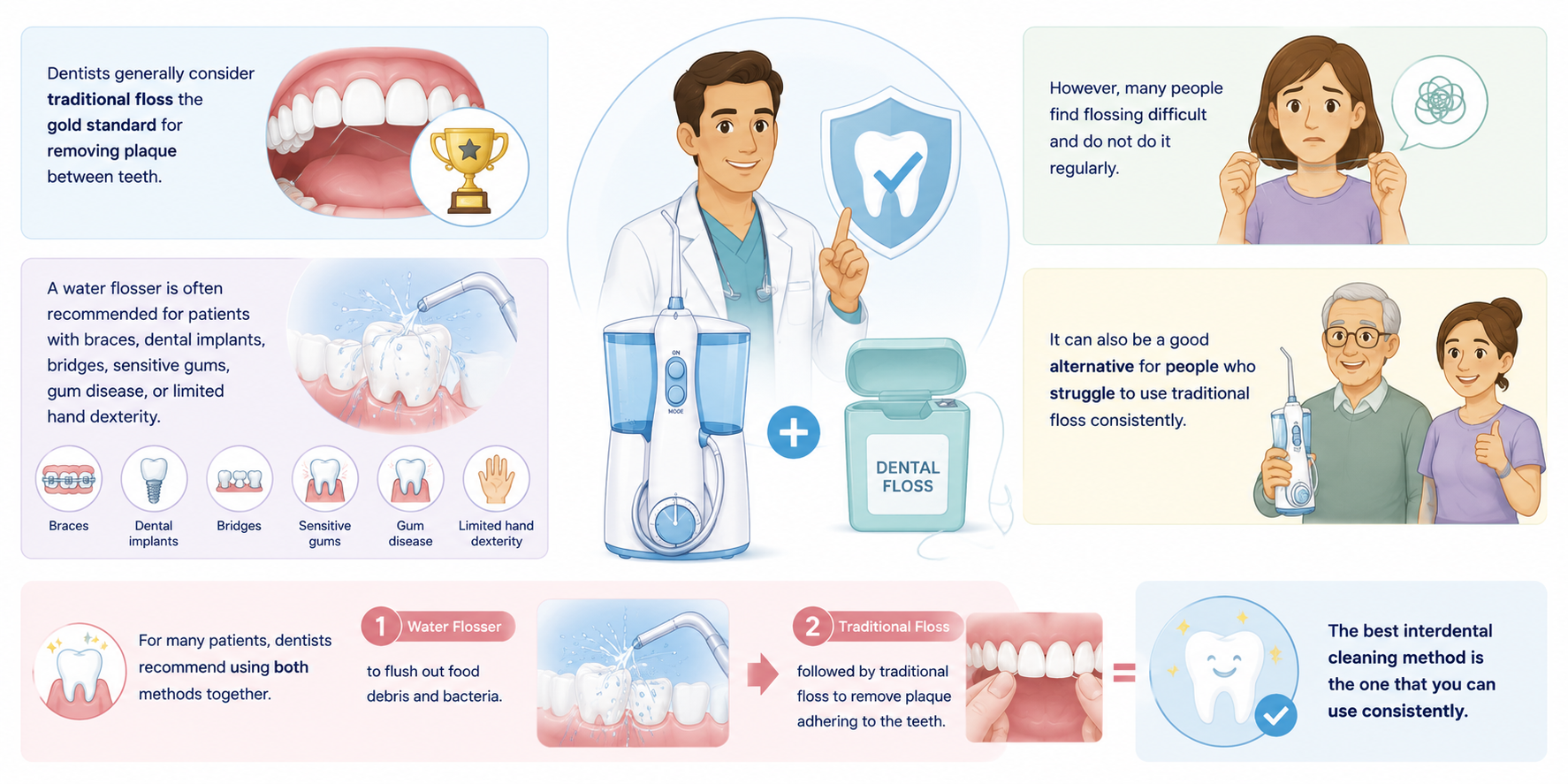
The best interdental cleaning method is the one that you can use correctly and consistently every day.
Key takeaways
- Brushing alone cannot effectively clean the spaces between teeth, where plaque, food particles, and bacteria often accumulate.
- Interdental cleaning helps remove this buildup, reducing the risk of cavities, bad breath, gingivitis, and gum disease. Cleaning between the teeth once daily is an essential part of maintaining healthy gums and a healthy smile.
- Both water flossers and traditional floss have advantages and limitations.
- Traditional floss remains highly effective for physically removing plaque, while water flossers offer convenience, comfort, and easier cleaning around braces, implants, and sensitive gums.
- The best interdental cleaning method is the one that you can use correctly and consistently every day.

Whether you use a water flosser or traditional floss, understanding tooth extraction aftercare can help you protect your smile.
Frequently Asked Questions
Is a water flosser better than floss?
The best choice depends on your oral condition and ability to use the device consistently.
Does a water flosser remove tartar?
No. Only professional dental cleaning can remove tartar.
Can children use water flossers?
Yes, with proper adult supervision.
How often should I use a water flosser?
Once daily before brushing is recommended.
Do water flossers stop gum bleeding?
They may help reduce inflammation-related bleeding, but persistent bleeding should be evaluated by a dentist.
Are water flossers safe for sensitive gums?
Yes. Water flossers are generally gentle on the gums and may help reduce bleeding and inflammation associated with gingivitis.
Why do my gums bleed when I floss?
Bleeding gums are often a sign of early gum disease. Regular and gentle flossing usually reduces bleeding within one to two weeks.
References
- Goyal CR, Lyle DM, Qaqish JG, Schuller R. Evaluation of the plaque removal efficacy of a water flosser compared with string floss in adults after a single use.
- American Academy of Periodontology. Oral Hygiene Tips. Chicago (IL): AAP
- Mayo Clinic. Oral health: A window to your overall health.


Member discussion