


Make your reproductive health No.1 priority!
Nowadays everyone has started prioritising their health and they want to know more about possible complications that can happen in future to prepare themselves in the present. Women are the ones who are the silent warriors fighting a lot of health problems silently, but the most important thing is being aware of the root cause. The problems related to their body parts should be considered as important as anything. The related problem is Ovarian cysts, which are fluid-filled sacs that develop on or inside the ovaries. They are extremely common, especially in women of reproductive age, and most are harmless. However, some cysts depending on their size, type, and symptoms can lead to complications such as rupture, internal bleeding, or ovarian torsion (twisting of the ovary), which may require emergency care.
So, what size of an ovarian cyst is considered dangerous? Let’s break it down clearly and factually.
Ovarian Cyst Risk by Size
| Cyst Size | Risk Level | Recommended Approach |
|---|---|---|
| Up to 3 cm | Very Low Risk | Usually normal, no treatment required |
| 3 – 5 cm | Low Risk | Follow-up ultrasound scan |
| 5 – 7 cm | Moderate Risk | Regular monitoring and check-ups |
| More than 7 cm | Higher Risk | MRI or specialist evaluation may be required |
| More than 10 cm | Very Concerning | Surgical evaluation is often recommended |
Size alone does not mean dangerous but symptoms and cyst type are equally important.
Understanding the Ovaries and Cyst Formation
The ovaries are two small reproductive organs located on either side of the uterus. They are attached to the uterus by ligaments and receive blood supply from the ovarian arteries which are basically the branches of the abdominal aorta.
Each month during the menstrual cycle, the ovaries produce follicles. One dominant follicle releases an egg during ovulation. Sometimes, instead of shrinking after releasing the egg, the follicle fills with fluid and forms a functional cyst.
There are over 30 types of ovarian masses, but most fall into two categories:
1. Functional (Benign) Cysts
- Follicular cysts: these are fluid-filled sacs which are usually harmless.
- Corpus luteum cysts: these cysts are formed on the ovary after egg is released, they are common and resolve on their own with time.
2. Complex or Pathological Cysts
- Dermoid cysts: these are benign ovarian cysts with tissue inside.
- Endometriomas: these are uterus lining growing outside uterus which causes pain.
- Cystadenomas: these are benign ovarian tumors with fluid-filled cysts.
- May require monitoring or surgery
When Is an Ovarian Cyst Dangerous?
An ovarian cyst becomes concerning when it:
- Grows larger than 7-10 cm
- Causes severe or persistent pain
- Ruptures
- Twists the ovary (torsion)
- Shows suspicious features on imaging
- Occurs after menopause
1. Ovarian Torsion (Medical Emergency)
Large cysts increase the risk of torsion.
Symptoms include:
- Sudden severe lower abdominal pain
- Nausea or vomiting
- Tenderness
Torsion cuts off blood supply to the ovary and requires urgent surgery.
2. Ruptured Cyst
A cyst can burst, leading to:
- Sharp sudden pain
- Internal bleeding
- Weakness or dizziness
Severe bleeding requires immediate treatment.
3. Hemorrhagic Cyst
These contain blood and may cause pain, but many resolve naturally.
4. Cancer Risk
Ovarian cancer is more likely in:
- Postmenopausal women
- Women with family history of ovarian or breast cancer
- Complex cysts with solid components
However, most ovarian cysts in reproductive-age women are benign.
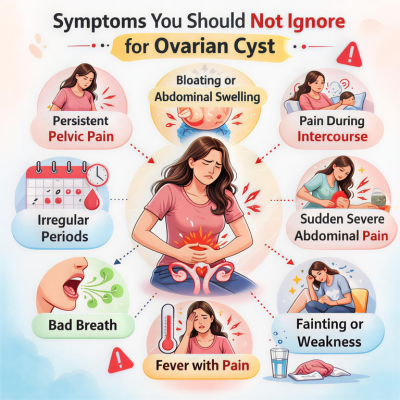
Symptoms You Should Not Ignore
Treatment Options
1. Watchful Waiting
- Most common approach
- Repeat ultrasound in 6–12 weeks
- Best for small, simple cysts
2. Medications
- Pain relievers
- Hormonal contraceptives (may prevent future cysts but do not shrink existing ones)
3. Surgery
Considered when:
- Cyst is large 7 to 10 cm
- Persistent or growing
- Suspicious for malignancy
- Causing severe symptoms
Types of surgeries are:
- Laparoscopy (minimally invasive)
- Laparotomy (for larger or suspicious masses)
Final Thoughts
The size of an ovarian cyst matters but it’s not the only factor. Many small cysts are harmless, and even some larger ones may not be dangerous if monitored properly. But you shouldn’t ignore the symptoms like severe pain, internal bleeding, imaging and postmenopausal cysts, as they can indicate higher risks. So, prioritise your reproductive health and get it checked timely to prevent complications.
FAQ's
Is a 4 cm ovarian cyst dangerous?
Usually no. Most 4 cm cysts are monitored and resolved naturally.
At what size is surgery required?
Often considered when cysts become larger than 7-10 cm or cause symptoms.
Can ovarian cysts go away on their own?
Yes. Most functional cysts disappear within a few menstrual cycles.
Are ovarian cysts common?
Yes they are common and about 20% of women develop at least one pelvic mass in their lifetime.
Is every ovarian cyst cancer?
No. The majority are benign, especially in younger women.
References
- National Institutes of Health (Ovarian Cyst)
- National Library of Medicine (Ovarian Cyst)
- American College of Obstetricians and Gynecologists
- Cleveland Clinic (Ovarian cysts: Causes, symptoms and treatment)


Member discussion