


If you’ve ever been asked to come back for a second test after a negative result, and you wonder why? Then you are at the right place.
Well, let’s know everything about the 2 step TB test, it will help in clearing your doubts. First let’s know about Tuberculosis (TB), it is basically an infectious disease caused by Mycobacterium tuberculosis. Even today, TB screening remains an important part of employment checks, hospital protocols, school admissions, and healthcare worker safety.
One of the most common screening tools is the TB skin test, also known as the Mantoux tuberculin skin test (TST). While many people know they need “a TB test,” what often gets overlooked is something called the two-step TB skin test which is a requirement that can catch people by surprise.
If you’ve ever been asked to come back for a second test after a negative result, this is why.
TB Skin Testing
Step 2 TB test can detect hidden TB infection but it can not detect active disease.
How the TB Skin Test Actually Works
The TB skin test uses a small amount of purified protein derivative (PPD), which is injected just under the skin of your forearm.
If your immune system has TB bacteria before, it recognizes the protein and creates a reaction. After 48 to 72 hours, a professional healthcare worker checks a firm bump (called induration) on the skin to see if the test is positive which means you have TB.
It’s important to understand that a positive test means that there is TB infection, but it does not necessarily mean active TB disease. Further tests, such as a chest X-ray, are needed to check out active disease.
Also, it can take 2 to 8 weeks after initial TB exposure for the immune system to react strongly enough for the test to detect infection.
Why Two-Step TB Testing Is Sometimes Needed
Here’s the part many people don’t know. Two step TB testing is needed because a single skin test can give a false negative result in few people who’ve had TB infection long ago. So in the first step the immune system becomes active and detects the infection in the second test. This is called the booster phenomenon.
To avoid confusing this boosted reaction with a new infection, healthcare providers use two-step testing.
- First test: if it comes negative after the test then they ask you to come 1-3 weeks later for a second test.
- Second Test: if it comes positive then it means you had TB infection in the past.
What Is Two-Step Testing?
If the first TB skin test is negative:
- A second TB skin test is done 1 to 3 weeks later.
- If the second test is positive, it is likely a boosted reaction from past infection, not a new TB infection.
- If the second test is negative, the person is considered uninfected at baseline.
This method helps prevent future confusion if the person undergoes annual TB screening.
Who Needs Two-Step Testing?
Two-step TB testing is commonly recommended for:
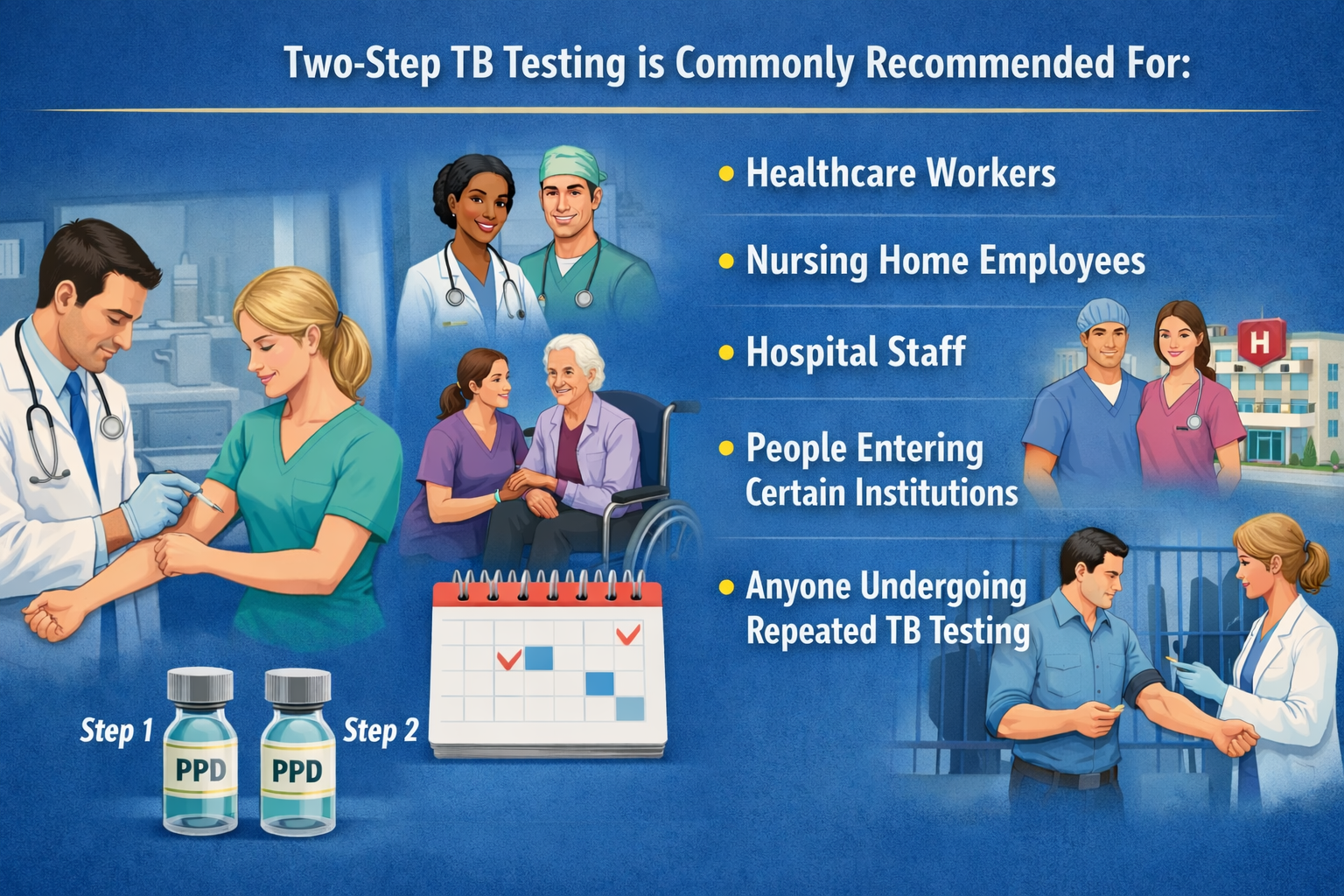
If someone already has a negative TB test within the past year, the second step may not be necessary.
TB Testing and Vaccines
Timing matters.
- Live virus vaccines (varicella) should be given on the same day as the TB test or at least one month before testing.
- Inactivated vaccines do not interfere.
- COVID-19 vaccination does not require delaying TB testing. Testing can be done before, during, or after COVID-19 vaccination.
Final Thoughts
The two-step TB skin test isn’t a mistake but it’s a safety measure. It makes sure that past TB infection hasn't been misunderstood as a new infection later.
If you’re starting a job in healthcare or another high-risk setting, don’t be surprised if you’re asked to return for that second test. It’s simply part of making sure that you had a TB infection before in the past or not.
FAQ's
Why do I need a second TB skin test if the first one was negative?
To check out a boosted reaction from a past infection.
Is two-step testing the same as TB conversion?
No. Conversion means new infection. Two-step testing identifies past infection.
Does BCG vaccination affect results?
Yes, it can cause false positive results in some cases.
How long after exposure does a TB test become positive?
Usually 2 to 8 weeks after infection.
Can I skip the second test?
If it’s required for baseline screening, skipping it may delay documentation clearance.
References
- Centers for Disease Control and Prevention (Clinical Testing Guidance for Tuberculin Skin Test)
- National Library of Medicine (Tuberculosis testing literature)
- World Health Organization (Tuberculosis screening principles)
Member discussion