


Are you wondering why your legs aren’t growing even though you’re squatting just as much as your gym partner? You both load the bar. You both hit similar reps. But somehow, their gain is visible but not yours. The truth is that it's not about weight.
It’s about the technique where you are going wrong.
Barbell squats are one of the most powerful exercises for building strength and muscle but small mistakes can limit gains and increase injury risk. Let’s know more about it.
The Top 5 Barbell Squat Mistakes
1. Wrong Bar Placement
One of the biggest mistakes that you can be making is placing the bar on the neck. This loads the cervical spine (neck area) and makes the bar unstable.
Correct Bar Positions:
First one is high bar squat:
- Bar rests on upper trapezius
- More upright torso
- Common in Olympic weightlifting
- Greater quad involvement
Second one is Low-Bar Squat:
- Bar rests slightly lower on mid-traps
- More torso lean
- Popular in powerlifting
- Allows heavier loads
- More glute and posterior chain activation
Beginners can try mid-position between high and low bar and go to high or low bar gradually with time.
2. Incorrect Foot Position
Many lifters follow the “shoulder-width apart” rule blindly.
Squat position depends on:
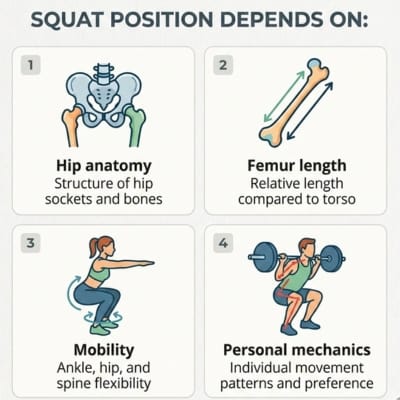
How to Find Your Ideal Stance:
- Perform bodyweight squats and adjust width
- Notice where you can squat deepest with a neutral spine
- Try a jump and wherever you land will be your natural squat position.
Your position may change as weight increases.
3. Knees Should Never Go Over Toes
This is one of the biggest misconceptions in fitness. Research shows that allowing knees to move past toes is natural and safe.
Forcing knees to stay behind toes often:
- Increases forward torso lean
- Puts more stress on the lower back
- Disrupts balance
Instead:
- Let knees track in line with toes
- Maintain balance mid-foot
- Keep spine neutral
4. Wearing the Wrong Shoes
If you are using running shoes, stop right there because running shoes are not made for stability.
The thick, soft sole compresses under load, which:
- Reduces force transfer
- Decreases stability
- Increases injury risk
Better Options:
- Flat shoes (hard sole)
- Weightlifting shoes with elevated heel (for mobility support)
- Firm cross-training shoes
Barefoot squats are fine for the beginners who are not doing squats with load but under heavy loads, stability matters.
5. Not Bracing and Stabilizing the Upper Body
Squats are not just a leg exercise.
If your upper body collapses under the bar:
- You lose power
- Your spine is at risk
- You limit performance
Fix It:
- Take a deep breath before lifting
- Brace your core (like preparing for a punch)
- Squeeze shoulder blades slightly
- Keep chest proud without overextending
A stable upper body means stronger squats.
6. Looking Too Far Up or Down
The neck position should stay neutral and your focus should be straight. Don’t look too you or down as it can cause injuries as well.
7. Loading Too Heavy Too Soon
If you are a beginner and are lifting too much weight just because your gym partner is lifting more than you then you need to stop right there. Let yourself get trained first and then go for heavy weight, otherwise you will have serious injury if done carelessly.
High Bar vs Low Bar Squat Comparison
Final Thoughts
If your squat gains have stopped, don’t immediately add weight. But instead look for the possibilities and fix them. Making your technique is much better than adding burden on you all of sudden.
FAQ's
Are barbell squats safe for beginners?
Yes, when performed with proper training and load.
Should beginners use high-bar or low-bar?
High-bar or a mid-bar position is generally easier to learn.
Is it okay if my knees go past my toes?
Yes, if it feels natural and your heels stay planted.
What shoes are best for squats?
Flat, firm shoes or weightlifting shoes.
References
- National Strength and Conditioning Association (Squat Technique and Biomechanic guidelines)
- American Council on Exercise (How to perform the Barbell Squat Safely and effectively)
- Journal of Strength and Conditioning Research By Schoenfeld


Member discussion