How Long Do Dissolvable Stitches Take To Dissolve? Timeline and Recovery

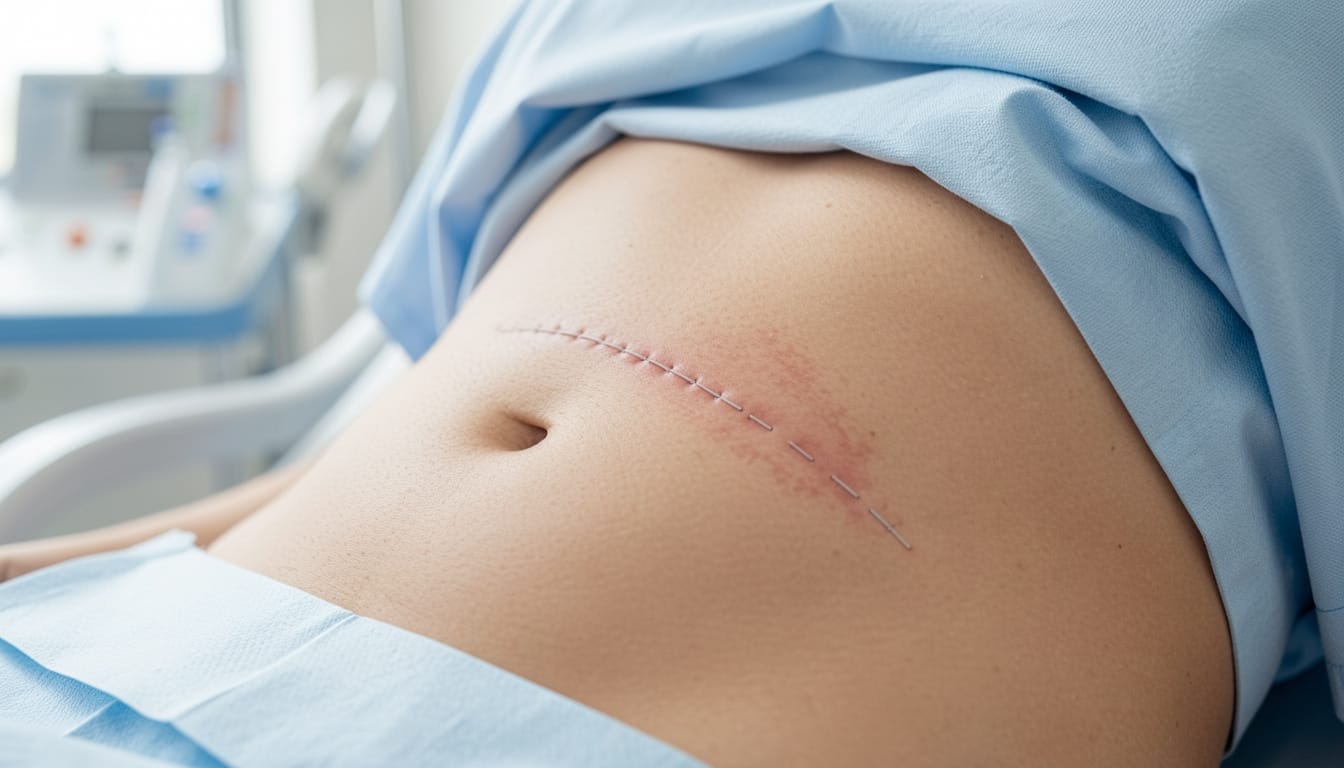
Dissolvable Stitches (dissolvable surgical sutures) are used to hold the tissues together at the site of operation once the surgical procedure is complete. What makes them unique is that they do not require surgical removal after healing rather they self dissolve. This means that they break down on their own making the patient experience comfortable as the need of surgical intervention, and suture cutting is eliminated.
A question which patients often ask doctors is how long do dissolvable stitches take to dissolve? The answer to this question is not universally the same for each patient and depends upon the type of suture material used, the site where the stitches are located, and individual healing factors . Some dissolvable stitches disappear within 1–2 weeks, but complete absorption can take several weeks to months .
What Are Dissolvable Stitches?
Dissolvable stitches (absorbable sutures) are medical grade threads which are used to hold wounds or incisions in place while healing occurs. They undergo self breakdown through the process of enzymatic breakdown or hydrolysis and do not require surgical cutting post healing.
Types of Dissolvable stitches
Natural
They are made of natural materials like proteins derived from animal intestines (called "catgut"). Your body's enzymes break these down over time.
Synthetic
Made up of lab/ synthetic derived material like polyglycolic acid (PGA), polyglactin (Vicryl), or polydioxanone (PDS). These dissolve through a process called hydrolysis, where water molecules gradually break down the chemical bonds in the thread.
Uses of Dissolvable stitches:
They are used to close surgical incisions after the following surgeries-
- Tooth extractions
- Wisdom tooth surgery
- Gum procedures
- Cesarean section
- Abdominal surgery
- Skin wounds
- Orthopedic procedures
How Are Dissolvable Stitches Different From Regular Stitches?
Non-dissolving stitches (nylon or silk) need a follow-up visit to be removed. They are not self dissolving and need to be removed by surgical cutting once healing is complete.
On the other hand, dissolvable stitches are the ones that dissolve on their own. No surgical cutting is required.
Dissolvable vs Non-Dissolvable Stitches
| Feature | Dissolvable | Non-Dissolvable |
|---|---|---|
| Need removal | No | Yes |
| Used internally | Yes | Sometimes |
| Visible long-term | Usually No | Yes |
| Follow-up needed | Less often | Usually Yes |
How Long Do Dissolvable Stitches Take to Dissolve?
The answer to the question how long until dissolvable stitches dissolve is not uniform. It is dependent upon two main factors first being the type of suture material being used and the second the location where the suture has been placed. The time line is variable lasting from 1-8 weeks.
On the basis of the suture material
Each dissolvable suture material has its own life depending upon its composition.
| Suture Type | Common Uses | Approximate Dissolution Time |
|---|---|---|
| Plain Gut | Minor skin lacerations | 5–10 days |
| Chromic Gut | Moderate-depth wounds | 10–21 days |
| Polyglycolic Acid (PGA) | General surgery and cosmetic procedures | 60–90 days |
| Polyglactin (Vicryl) | Facial, hand, and soft tissue wound closure | 56–70 days |
| Poliglecaprone (Monocryl) | Skin closure with minimal scarring | 90–120 days |
| Polydioxanone (PDS) | Deep tissue repair and orthopedic surgery | 180–210 days |
On the basis of location of the dissolvable suture in the body
Location equally matters when it comes to the dissolving timeline. Healing and blood flow is different in each part of the body thus the time required for dissolution is also different.
- Mouth (Dental): Dental dissolvable stitches dissolve within 7–14 days due to rapid healing and rich blood supply.
- Skin surface: They begin loosening by 1–2 weeks, with most gone by 3–4 weeks.
- Deep tissue: last for 4–12 weeks before fully dissolving.
- After a C-section: Doctors typically choose sutures designed to last up to 6 weeks, matching the extended healing time of the uterus and abdominal layers.
- After orthopedic surgery : Long-lasting sutures may not dissolve for several months, as bone and tendon tissue takes much more time to heal.
Factors Affecting How Long Until Dissolvable Stitches Dissolve
Your stitches don't work on a universal clock. Several things influence how quickly (or slowly) they break down:
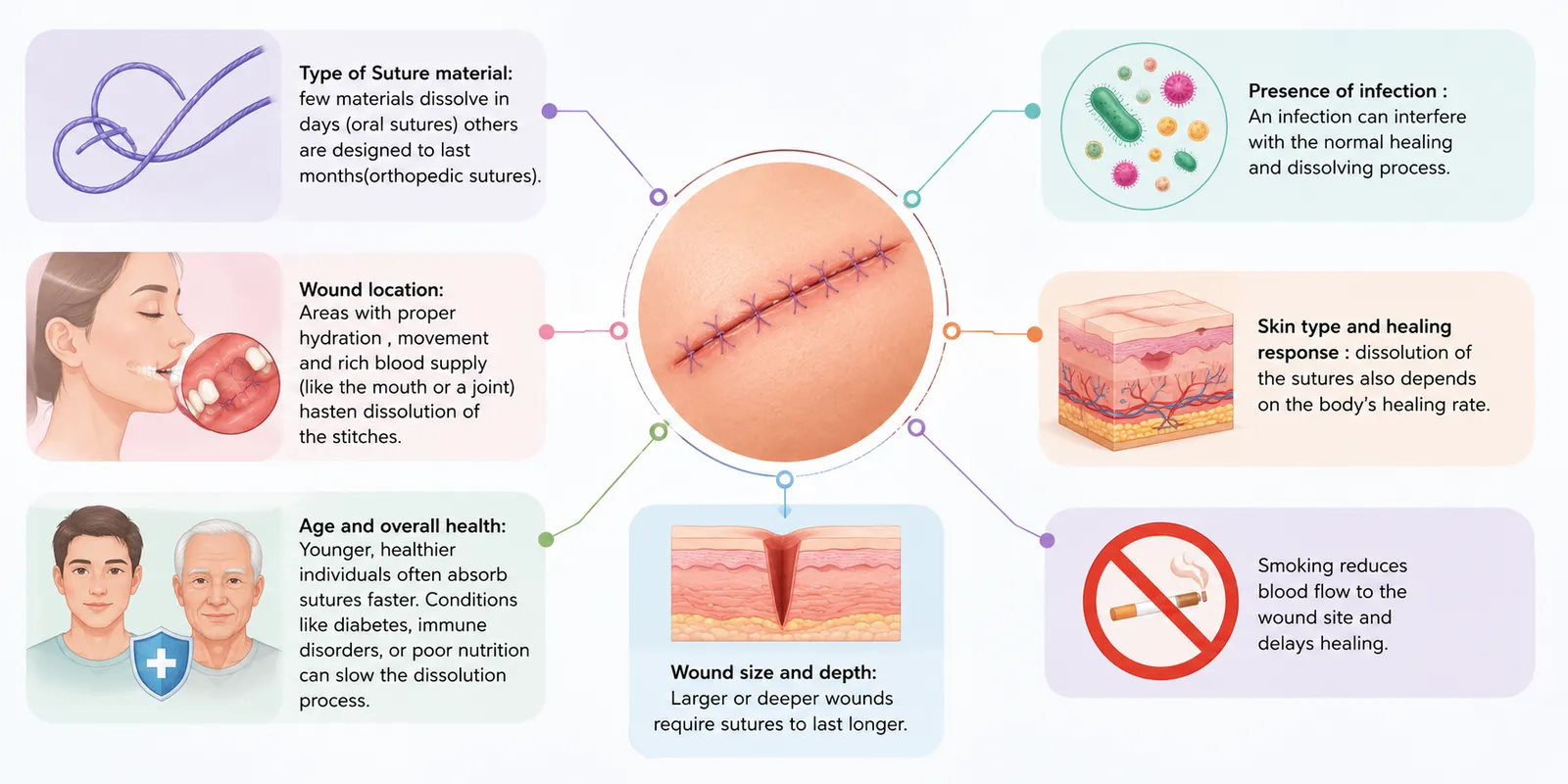
Timeline and Recovery of Dissolvable Stitches
Here is a timeline for how long until dissolvable stitches dissolve. The timeline is not universal for each patient and depends upon the location and type of suture material that is being used.
Days 1–3:
This is known as the Inflammation phase as after getting stitches, the body immediately goes into protective mode.
- Mild swelling, warmth, and redness around the wound
- A small amount of clear or slightly yellowish fluid (called serous drainage) is normally seen around the wound.
- You might experience mild soreness and tenderness.
- The stitches at this time holding the wound edges together.
- NOTE: Redness, swelling, and warmth are normal in the first 3–4 days. If these symptoms worsen or continue after day 4, medical attention is required.
Days 4–14:
In this phase wound healing is initiated. Inflammation is now replaced by a phase of active wound repair.
- Swelling begins to decrease
- The wound edges start to pull together and close roughly approximating each other.
- Mild itching might occur which is a sign of active repair and healing.
- The stitches may start to loosen slightly as they begin to break down (especially fast-dissolving types like dental stitches).
- Skin is still very fragile during this phase of healing any urge to scratch should be avoided.
Weeks 2–4:
This is the stage from where repair shifts to active remodeling during wound healing.
- Bruising begins to fade
- A raised scar line or ridge may form ("mountain top" effect) and is part of normal scar tissue formation.
- Small pieces of suture material start pushing up through the skin surface.
- It is called "spitting sutures" and means the body is ejecting the dissolving thread.
- The stitches themselves may become lighter in color, feel softer, and start to fall away in small pieces.
Weeks 4–8 and After that
For deeper or longer-lasting sutures this is the phase of continuous absorption & scar maturation
- Deeper threads are still being absorbed in the body
- The scar continues to fade and flatten over the coming months.
- Few patients may feel small firm knots or lines under the skin. It is a sign that tissue remodelling is still occurring under the scar area.
- Collagen production continues. It gradually improves the strength of the healed tissue.
- Superficial healing might be complete.
- Internal healing can continue for 6–12 months even after the visible wound looks fully closed.
How to Care for Dissolvable Stitches at Home?
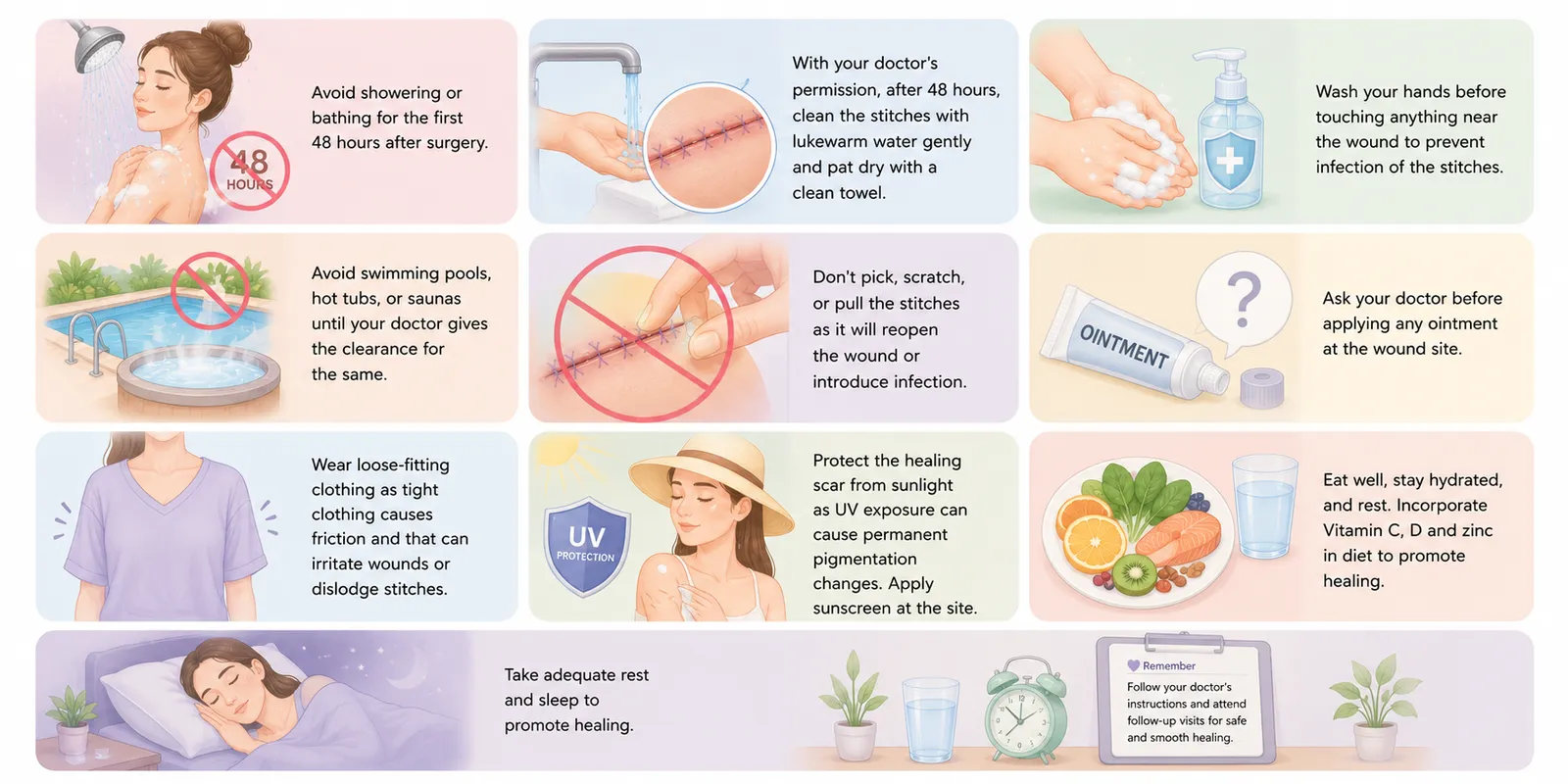
What Do Normal Healing Dissolvable Stitches Look Like?
Dissolvable stitches have different appearance depending upon the material used and location of stitches.
During the first few days of healing, the stitches may appear as threads that are white, beige, clear, blue, or purple, with mild redness and swelling around the wound. As healing progresses, the surrounding tissue should gradually become less swollen and tender. Over the next one to three weeks, dissolvable stitches may:
- Become loose
- Curl at the ends
- Fray into smaller pieces
- Protrude slightly from the skin or gums
- Fall out on their own


Consult a dermatologist
Signs of Stitches Dissolving Properly
After receiving dissolvable stitches, here are common signs to look for that ensure proper healing:
- Gradual reduction in redness, swelling and pain
- Wound edges stay well approximated
- Minimal clear drainage
- Thread fraying or falling out with mild protrusion of stitches
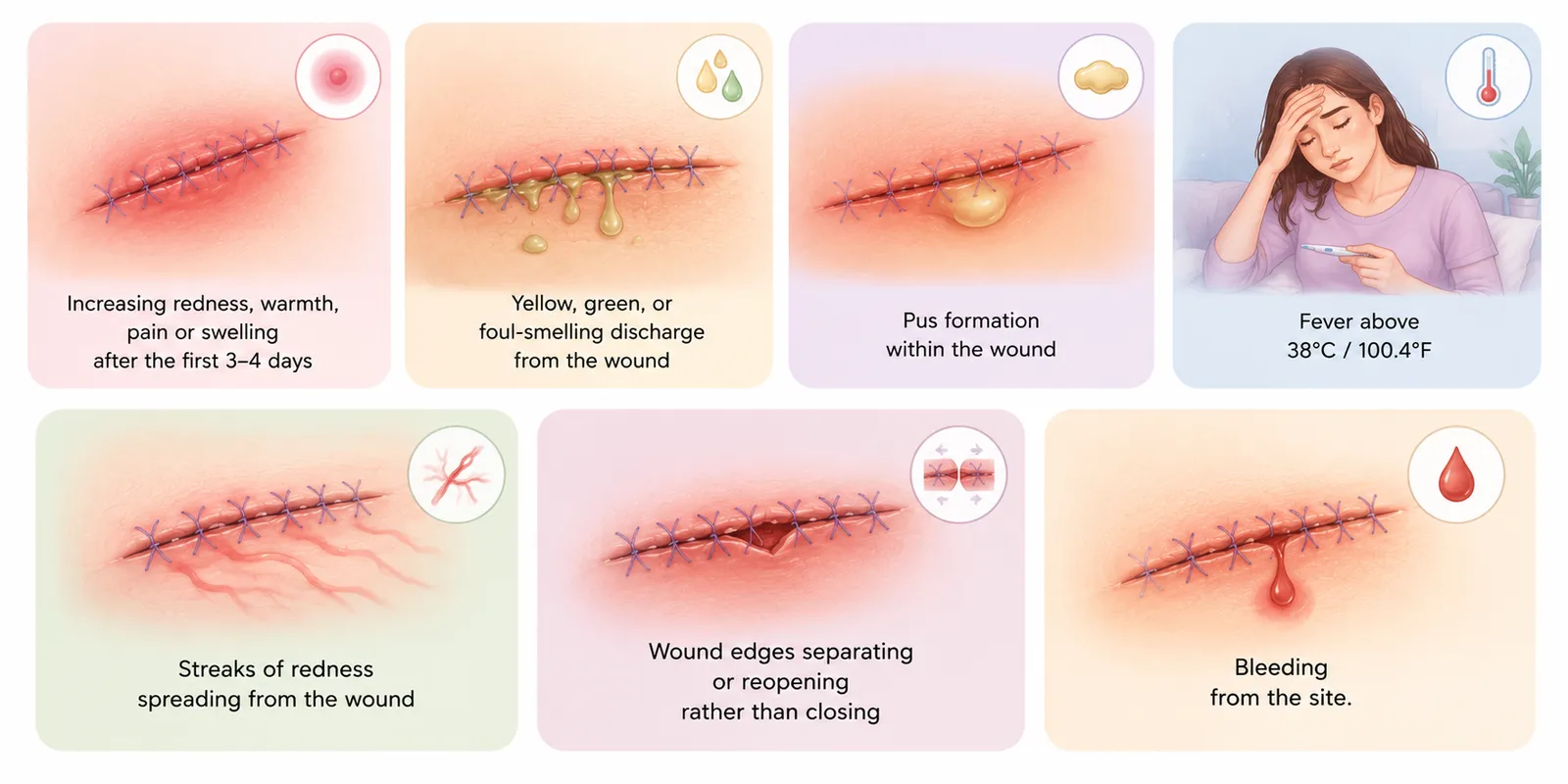
Signs Of Infection in Dissolvable Stitches
Should You Ever Remove Dissolvable Stitches At Home?
Dissolvable stitches should not be removed because they are designed to self dissolve and be absorbed by the body over time.It is not recommended to pull out or cut dissolvable stitches at home. Removing them too early can cause the wound to reopen, bleed, heal poorly or become infected.
If the stitches are causing irritation due to fraying or remain persistent even after healing is complete , contact your healthcare professional. They can determine whether the wound has healed enough and safely trim or remove any remaining suture material. At times the doctor may trim them like in cases where:
- remain in place longer than expected
- stitches are protruding from the wound like tongue or gums causing difficulty in function and have a chance to reopen the wound.
- wound has healed, but the stitches have not dissolved
- signs of irritation or infection
Complications of Dissolvable Sutures
Dissolvable (absorbable) sutures are designed to break down naturally in the body over time. They are safe but occasionally they might develop complications
1. Infection
Bacteria can grow around sutures, causing infection at the wound site especially if hygiene is not maintained.
Signs of infection include:
- Increasing redness, swelling warmth and pain around the wound
- Pus formation or foul-smelling discharge
- Fever
2. Suture Reaction (Foreign Body Reaction)
Some people develop an allergic response to the suture material itself
Symptoms may include:
- Persistent redness, swelling, pain and tenderness
- Small bumps or nodules along the incision
- Delayed healing
3. Spitting Sutures
Occasionally, the body pushes partially dissolved sutures toward the skin surface instead of absorbing them completely. They are harmless but require removal by your doctor.
Signs include:
- A small white or clear thread protruding from the wound
- Mild irritation or tenderness
- Tiny pimple-like bumps
4. Delayed Wound Healing
If sutures dissolve too quickly the wound may take longer to heal.
Risk factors include:
- Diabetes, smoking, poor nutrition all delay healing
- Infection
- Use of steroids or immunosuppressive medications
5. Wound Separation (Dehiscence)
Rarely, absorbable sutures lose strength before the wound has healed adequately, causing the edges to pull apart. Immediately visit your doctor in case you suspect wound dehiscence.
Symptoms:
- Gaping wound edges
- Bleeding
- Pain
6. Suture Granuloma
A granuloma is a small lump of inflammatory tissue that forms around retained suture material which is not dissolved completely.
Features:
- Firm, painless or mildly tender bump
- Appears weeks to months after surgery
- May occasionally drain fluid
7. Allergic Reaction
True allergies to absorbable sutures are uncommon but can occur.
Possible symptoms:
- Severe itching
- Widespread rash
- Significant swelling
- Persistent redness despite proper wound care
When Should You See A Doctor?
- Stitches that haven't dissolved past the timeline told by your doctor
- Severe or worsening pain
- A visible lump or hard bump forming near the wound
- Stitches that feel like they've come completely loose before the wound is healed
- Stitches appear to have become infected.
References
- Incision & Surgical Wound Care: Sutures, Stitches, Steri-Strips & Staples – Cleveland Clinic · source
- Absorbable Sutures – Leeds Teaching Hospitals NHS Trust · source
- Wound Closure Techniques – StatPearls Publishing (NCBI Bookshelf) · source
- Sutures and Needles – StatPearls Publishing (NCBI Bookshelf) · source
- Proper wound care: How to minimize a scar – American Academy of Dermatology · source
Frequently asked questions
Can I make my dissolvable stitches dissolve faster?
No. There is no safe way to speed up the process. Soaking the wound or using chemicals or ointments to break the stitches down faster can damage the incision and slow healing. Let them absorb on their own and follow your provider's wound-care advice.
What do dissolvable stitches feel like as they dissolve?
You may notice mild itching, the stitches softening or loosening, or small fragments of suture fraying or falling away. This is normal. Persistent pain, spreading redness, or discharge is not, and should be checked by a doctor.
Is it normal for dissolvable stitches to turn white or change appearance?
Yes. As they absorb moisture and begin breaking down, dissolvable stitches often lighten or turn white. This colour change is a normal part of the process and is not a sign of infection.
What happens if dissolvable stitches do not dissolve completely?
Depending on the material, some dissolvable stitches take several weeks to a few months to disappear. If they stay visible, feel bothersome, or have not dissolved within the expected time, see a healthcare professional, who can assess them and remove them if needed.
Can dissolvable stitches get infected?
The stitches themselves rarely cause infection, but bacteria can build up around any suture material. Keeping the wound clean and dry lowers the risk. Seek care for increasing pain, redness, warmth, swelling, pus, or fever, which can signal a wound infection.
Should I pull out a dissolvable stitch that is poking out or hanging loose?
No. Do not cut or pull stitches yourself, even if a loose end is poking the skin. You could reopen the wound or introduce infection. If a stitch is irritating you or a piece is hanging, ask your doctor or nurse to trim or remove it safely.