


You might have gone through the pain caused by wisdom teeth. It happens at the back of the mouth all of sudden without giving any warning. Your daily tasks like eating, even drinking, become difficult and painful. If you are going through this right now, you are far from alone.
Let’s understand what wisdom teeth actually are, the causes of pain, home remedies that genuinely help, signs that you need to see a dentist urgently, and what happens during and after extraction.
Understanding Wisdom Teeth
There are four wisdom teeth in total, one in each of the furthest corners of the top and bottom gums. They typically push through the gums when a person is between the ages of 17 and 21.
Modern diets and dental evolution have led to smaller jaws, leaving little room for wisdom teeth to grow. As a result, they may come in at an angle, get stuck entirely, or crowd neighbouring teeth. The discomfort may feel sharp, dull, or throbbing and can spread into the jaw, ear, or throat. Many people experience pain that comes and goes, which is often a sign that the tooth is not erupting correctly.
What Causes Wisdom Tooth Pain?
Understanding the cause of your pain is very useful because it shapes what kind of relief will work in the short term, and how urgently you need professional care.
Impaction
When a wisdom tooth cannot emerge fully because of lack of space, it becomes impacted. These teeth don't have enough room to come in or develop properly, leading to pain, damage to other teeth, and other dental problems. Impacted teeth can press against adjacent molars, create cysts in the jawbone, and generate persistent pressure that is felt well beyond the tooth itself.
There are different degrees of impaction. Some wisdom teeth are partially visible through the gum but cannot complete their eruption. Others remain fully buried beneath the bone. Each scenario carries its own set of complications.
Pericoronitis: Infection Beneath the Gum Flap
If you have an impacted wisdom tooth, a gum flap can form over the top of it which is called an operculum. Food, bacteria, and debris can get trapped underneath the operculum and cause infection.
This condition, called pericoronitis, is most common in people aged 20 to 29 and affects all sexes equally. It can be acute which can arrive suddenly with intense symptoms like chronic, with recurring bouts of mild discomfort and bad breath that keep coming back until the underlying problem is addressed.
Crowding and Pressure on Adjacent Teeth
New molars can push other teeth out of alignment, causing discomfort that spreads further forward in the mouth. Patients sometimes visit a dentist complaining of pain in their existing molars, only to discover that the real culprit is a wisdom tooth exerting pressure from behind.
Decay and Cavities
Wisdom teeth are tricky to clean due to their position, increasing the risk of cavities. A partially erupted tooth is especially vulnerable because the gum tissue around it creates a pocket where bacteria accumulate and brushing cannot reach effectively.
Cysts
Though rare, cysts can form around impacted teeth, damaging the jawbone or nearby teeth. These require prompt treatment to prevent structural damage that can become significantly more complex to manage over time.
Common Symptoms
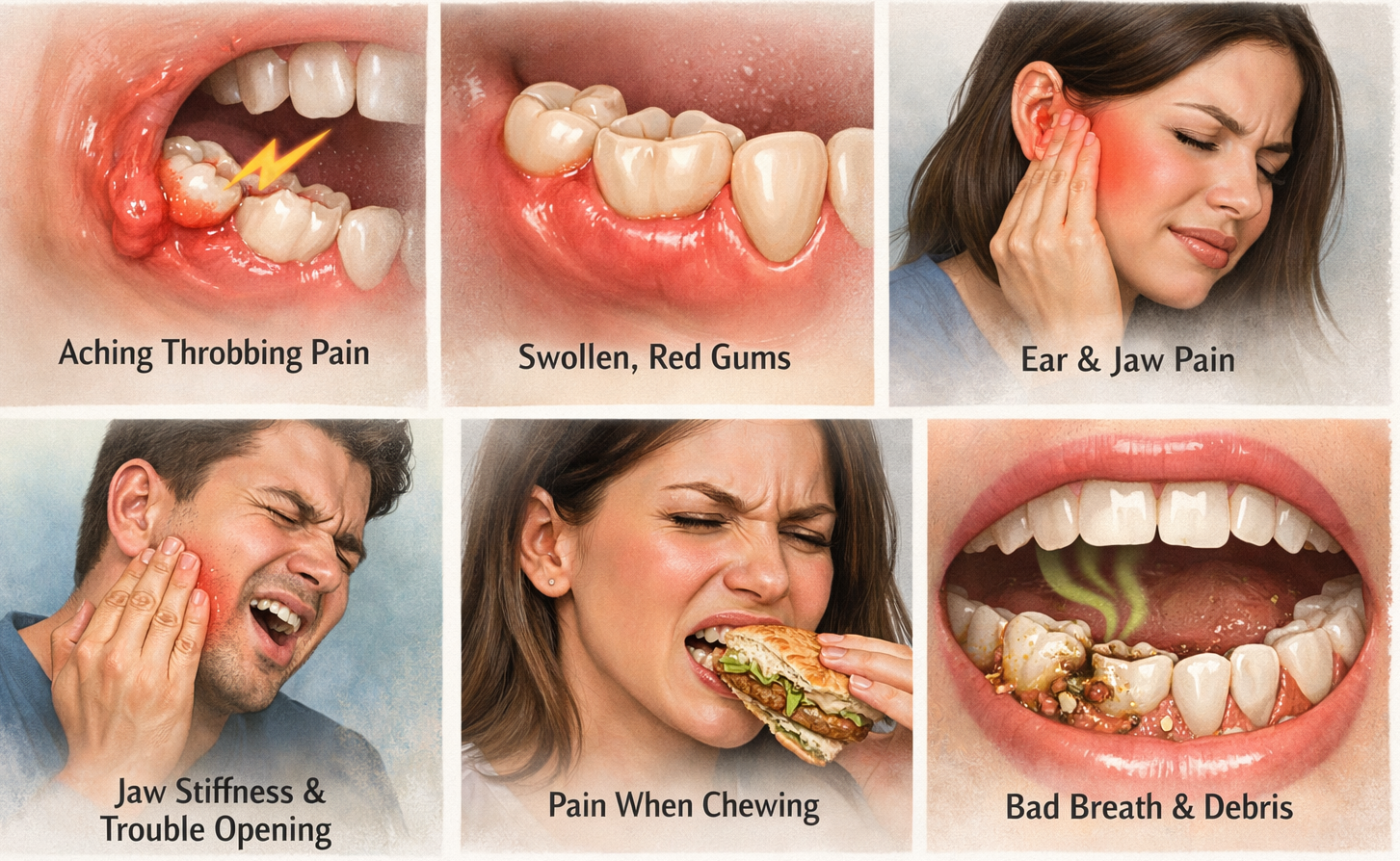
Signs of Infection
A developed infection can cause a foul taste in the mouth, pus, facial swelling, and even fever. All of these symptoms signal the need for immediate dental care before the situation gets worse.
A wisdom tooth may be infected if there is:
- Swelling
- worsening pain
- Fever
- A bad taste
- Difficulty opening the mouth.
Infections often develop when bacteria become trapped under a gum flap covering a partially erupted tooth.
Home Remedies That Can Help
When you feel pain in your wisdom teeth and a dental appointment is still hours or days away, several home management strategies can provide genuine, meaningful relief. It is important to understand upfront that these approaches address the symptom.
Ibuprofen
Ibuprofen is an OTC pain relief medication and a type of nonsteroidal anti-inflammatory drug (NSAID). Taking the recommended dose on the packet may help relieve discomfort and reduce inflammation of the gums associated with wisdom teeth development.
Cold Compress
Using ice can help reduce inflammation, which in turn may relieve pain, and can have a numbing effect. Try holding an ice pack with a tea towel around it against the jaw for up to 15 minutes. Repeat several times a day during the first 24 to 48 hours of a flare-up.
Warm Saltwater Rinse
Rinsing the mouth with warm saltwater three to four times a day is a simple, evidence-supported way to reduce bacteria around the affected area.
Numbing Dental Gels
Numbing gels containing benzocaine may help reduce feeling in the gums and dull the pain. These gels are available over the counter and can be applied to the affected gums throughout the day following the product's instructions. They are useful for short-term relief but should not be used continuously as a substitute for dental treatment.
Clove Oil
Clove oil contains eugenol, a natural anaesthetic compound that has been used in dentistry for generations. Applying a small amount to a cotton ball and holding it gently against the painful gum can produce temporary numbing. It does not treat the underlying issue, but it can provide relief from the pain for the time being.
When to See a Dentist
You should see a dentist if:
- If symptoms last longer than 48 hours
- If pain relievers do not help
- If the pain interferes with daily activities such as eating, talking, or sleeping
Long-Term Risks of Leaving a Painful Wisdom Tooth Untreated
Choosing to live with pain in your wisdom teeth or repeatedly managing it with home remedies is not a good decision. Over time, an impacted or infected wisdom tooth can set off a chain of complications that are significantly harder to address than the original problem.
- Spreading infection
- Damage to adjacent teeth
- Gum disease Sinus complications
- Cyst formation
When Should You Seek Emergency Dental Care?
If it crosses crosses into dental emergency territory in these situations:
- Fever accompanied by jaw or facial pain
- Swelling that is spreading visibly toward the throat or neck
- Difficulty swallowing or breathing
- Inability to open the mouth beyond a very limited range
- Pus or an abscess visible around the tooth
- Pain that is completely unresponsive to prescription-strength painkillers
Do not wait for a scheduled appointment in these scenarios. Contact an emergency dental service or go directly to an urgent care facility.
Final Thought
Pain in last part of your mouth is among the most common dental complaints in adults. The experience is deeply individual, shaped by the position of the tooth, the health of surrounding tissue, and how quickly the problem is addressed.
If your pain has been present for more than a day or two, or if it has returned more than once, that is your signal to make the call. A dentist or oral surgeon can assess what is actually happening and offer a clear, straightforward path to relief.
Frequently Asked Questions
Why does pain in wisdom tooth come and go?
The tooth may be erupting in small stages, meaning the surrounding gum tissue becomes irritated only during certain periods. Recurring pain is a strong indicator that the problem is structural rather than temporary.
How long does pain in wisdom tooth last without treatment?
It largely depends on whether the tooth becomes impacted or manages to emerge fully.
Can I just take painkillers and wait it out?
Yes, but for a short-time period only. If there is still pain you should see a dentist immediately.
Do all four wisdom teeth need to come out?
Not necessarily. Each tooth is evaluated individually. Some wisdom teeth erupt correctly, stay clean, and never cause problems.
References
- Medical News Today (Ways to relieve painful wisdom teeth)
- Mayo Clinic (Impacted wisdom teeth: Symptom and causes)
- Cleveland Clinic (Impacted wisdom teeth: Signs, symptoms and causes)


Member discussion