


If you have ever felt a soft, doughy lump beneath your skin that moves slightly when you press it, there is a good chance you have a lipoma. These fatty growths are among the most common harmless soft-tissue tumors in adults, yet they remain widely misunderstood. Let’s understand what a lipoma actually is, to who develops them, how they are diagnosed, and why removal may be the right decision for your health and quality of life.
What is Lipoma
A lipoma is a slow-growing, non-cancerous round shaped lump that can happen anywhere in your body. It typically sits just below the skin and above the muscle layer which is close enough to see and feel, but not dangerous on its own. According to the American Academy of Orthopaedic Surgeons, lipomas are the most common soft-tissue tumors found in adults.
Key Fact: Approximately 1% of people develop at least one lipoma in their lifetime, and they appear most frequently between the ages of 40 and 60. Multiple lipomas can occur simultaneously, and men are slightly more likely to develop them than women.
Types of Lipomas
Not all lipomas are same, there are different t subtypes have been identified, each with slightly different cellular characteristics:
Conventional lipoma:
The most common type, made up of white fat cells just beneath the skin.
Angiolipoma:
Contains both fat and blood vessels which is more likely to be tender or painful.
Fibrolipoma:
Includes fibrous tissue alongside the fat cells, giving it a firmer feel.
Spindle cell lipoma:
A rarer variant with spindle-shaped cells which is more common in older men.
Pleomorphic lipoma:
Contains cells of different shapes and sizes.
Hibernoma:
A rare type made from brown fat cells rather than the usual white fat.
Each subtype may present differently in terms of pain, consistency, and location, which is why it is important to examine it on time.
What Causes a Lipoma?
The exact cause of lipoma is yet to be studied. According to Medical research it can be because of a combination of genetic, environmental, and physiological factors.
Genetic
Lipomas tend to run in families, and a rare inherited condition called familial multiple lipomatosis causes individuals to develop numerous lipomas across the body. If a close relative has had a lipoma, your likelihood to get lipoma as well.
Associated Medical Conditions
In some cases, lipomas appear as a feature of specific underlying disorders:
- Dercum's disease: a rare condition causing multiple painful lipomas, particularly in middle-aged women.
- Gardner syndrome: a genetic disorder that promotes lipoma growth alongside intestinal polyps.
- Madelung's disease: linked to excessive alcohol use in some individuals, causing lipomas around the neck, shoulders, and upper trunk.
- Cowden syndrome: another rare genetic condition that includes lipomas among multiple physical features.
Physical Trauma
Some patients report noticing a lipoma after a physical injury to a specific area.
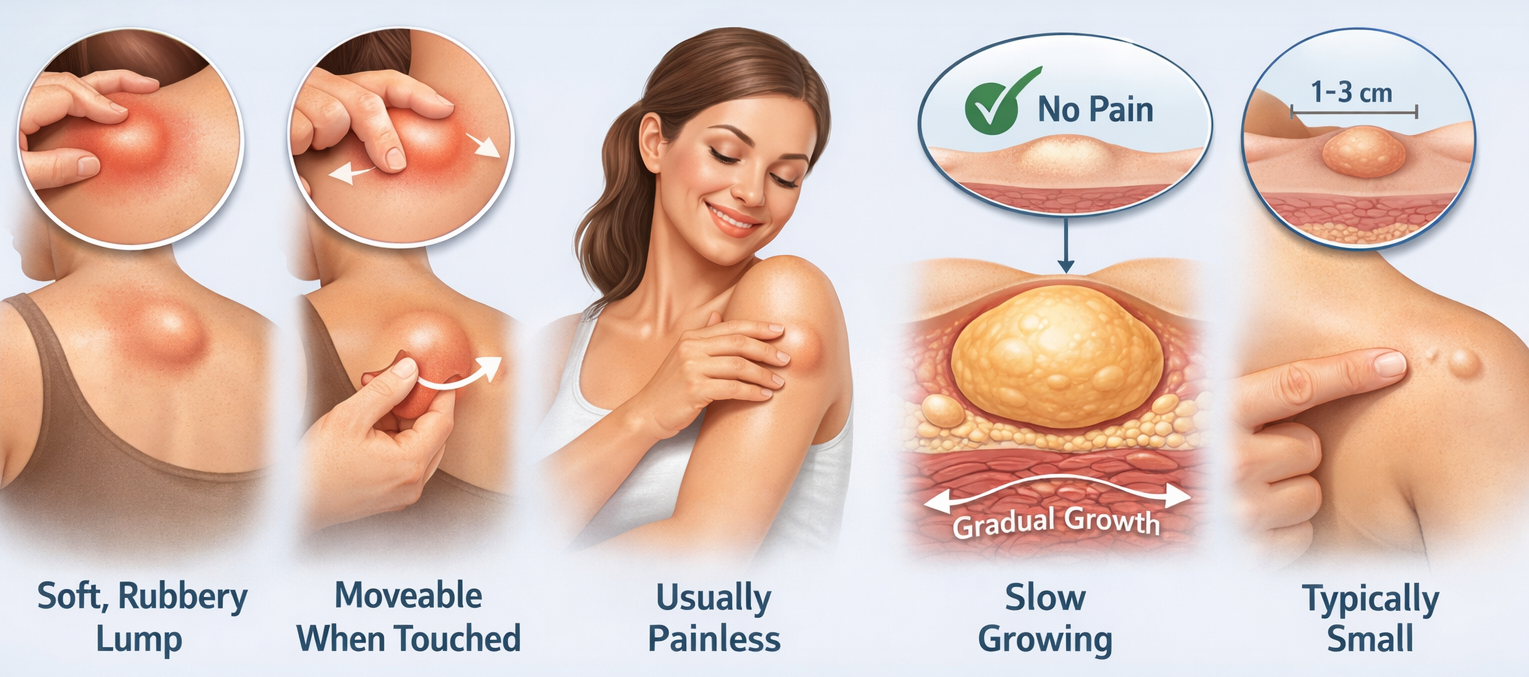
Symptoms of Lipoma
How Lipomas Are Diagnosed
In the majority of cases, a doctor can diagnose a lipoma through a straightforward physical examination alone. The combination of soft texture, mobility, and gradual growth is usually enough for a confident diagnosis.
Physical Examination
A clinician will examine the lump by checking the size, consistency, and mobility. They will ask about how long it has been present, whether it has grown, and whether it causes any pain. Most lipomas are diagnosed at this stage.
Imaging Studies
When the lipoma is unusually large, deep, or atypical in its features, imaging like:
- Ultrasound
- MRI (Magnetic Resonance Imaging)
- CT scan
- X-ray
- Biopsy
Treatment Options for Removal of Lipoma
Surgical Excision
The most widely used and effective method to remove the lipomas is surgical excision. The procedure is typically performed under local anaesthesia in a doctor's office or outpatient setting. The surgeon makes a clear cut over the lipoma, shells the fatty mass out intact within its capsule, and closes the wound with stitching.
Liposuction-Assisted Removal
A combined approach which means it uses liposuction to remove the bulk of the mass followed by direct excision of the capsule through the same small cut.
Steroid Injection
Corticosteroid injections can cause a lipoma to shrink, but they do not eliminate the growth entirely. This approach is generally reserved for patients who are unwilling or unable to undergo surgery, or for small, isolated lipomas in cosmetically sensitive areas. It is not a curative option.
Health Benefits of Lipoma Removal
- Reduced Risk of Recurrence When Done Correctly
- Improved Cosmetic Appearance and Body Confidence
- Prevention of Complications from Continued Growth
- It gives clarity that the lipomas were harmless and there is no sign of cancer
- Good for those who have difficulty in moving their joints because of lipomas
- Complete and Long-Lasting Pain Relief
Risks and Considerations
It is a safe and well-established procedure, but like all surgical interventions, it carries a small set of possible complications.
Early warning signs are:
- Infection
- Haematoma or seroma which is basically an accumulation of blood or fluid beneath the skin.
- Scarring
- Nerve or vessel injury
- Incomplete removal
Important Note: Patients with diabetes, immunosuppression, or those taking blood-thinning medications should discuss these factors with their surgeon beforehand.
Final Thoughts
A lipoma is a harmless, manageable condition that affects a lot of people worldwide. While many require no treatment at all, removal is a well-supported option offering real, lasting benefits. –Early evaluation ensures peace of mind, and if removal is appropriate, timing it while the lipoma is still small typically means a simpler procedure and faster recovery.
Understanding your condition is the foundation of making informed decisions about your health. With the right information and the right clinical team, lipoma removal is straightforward, safe, and often genuinely life-improving.
Frequently Asked Questions
Are lipomas a warning?
They are generally harmless and common but if it comes with other symptoms as well like pain, hard skin then you must consider an evaluation by healthcare.
How painful is lipoma removal surgery?
Lipoma removal surgery is usually mildly painful, with most people feeling only slight soreness or discomfort rather than significant pain.
Can I poke a lipoma with a needle?
No, you shouldn’t poke a lipoma with a needle, because it can cause infection, bleeding, and won’t actually remove the lipoma.
References
- Cleveland Clinic (Lipoma: What is lipoma, cause, symptoms)
- Mayo Clinic (Lipoma: Symptoms and Causes)
- National Institute of Health (Lipoma)


Member discussion