


Not every Lump is cancer!
Finding a lump under your skin can be alarming and a bit scary if you don’t know much about Lipoma. Your mind may immediately jump to worst-case scenarios. But not every lump is dangerous. So just calm down first and examine it with your finger. Lipoma is the soft lump under the skin which can slide by applying pressure from your finger. It’s normally common in everyone and harmless so there is no need for worrying about it. Still, not every lump is lipoma, you need to be careful enough and get help if needed. Let’s understand about Lipoma and how you save yourself by getting your lumps checked on time. So that there is no room left for confusion.
What Is a Lipoma?
A lipoma is a soft, fatty lump that grows just under the skin. It is soft in touch and often harmless. Lipomas are the most common soft tissue tumors in adults.
They:
- Grow slowly
- Feel soft or doughy
- Move slightly when pressed
- Are usually painless
- Are not attached firmly to the skin
Don’t confuse lipomas with cancer because it is common that can happen in middle age to anyone. But still, a rare cancerous tumor called liposarcoma can sometimes resemble a lipoma which is why it’s important if you get it checked from healthcare professionals.
Lipoma at a Glance
| Feature | Lipoma Characteristics |
|---|---|
| Age Group | Most common between 40–60 years |
| Cancer Risk | Very rare |
| Texture | Soft, rubbery, dough-like |
| Pain | Usually painless |
| Movement | Moves slightly under the skin |
| Size | Commonly 1–5 cm (can grow larger) |
| Growth Speed | Slow |
Where Do Lipomas Usually Appear?
Lipomas are soft tissues which are painless and can occur anywhere on the body. It is mentioned in the National Institute of Medicine report on lipomas that about 1 in every thousand persons will have lipoma at some point of their life.
Let’s know the common places where lipomas can be found on:
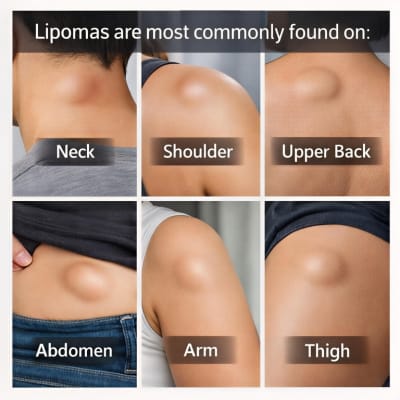
These areas naturally contain more fat tissue, which explains why lipomas often appear there. Lipomas can be more than one on the body that’s why some people notice multiple lipomas on their body, which is a condition known as familial multiple lipomatosis.
Symptoms
- Lipomas are usually round in shape , soft and doughy when touched.
- The lipomas are under the skin and can be moved with gentle pushing.
- Lipomas are painless, but some rare cases of Lipomas can be painful, such as angiolipoma.
7 Signs You Shouldn’t Ignore
While lipomas are usually harmless, there are few reasons associated with it which need medical attention.
1. The Lump Is Rapidly Growing
Lipomas are around 1-5 cm but it’s not its permanent size as size changes over time but slowly. . If a lump increases in size quickly, it should be checked by a doctor. Keep noticing such change and get medical help on time.
2. It Becomes Painful
Lipomas are soft tissues which are painless when touched. If you notice pain in lumps it can be due to:
- The lump presses on nearby nerves
- It contains blood vessels (angiolipoma)
If the pain is not going and it continues then get it checked by a doctor immediately.
3. The Lump Feels Hard or Fixed
Lipomas are soft and movable when touched.
But if the lump feels:
- Firm or hard
- Deep
- Fixed in place
Get it checked by a doctor and treat it on time.
4. It’s Larger Than 5 cm
Most lipomas are small and their size is between 1-5 cm. But if the lump gradually increases its size quickly, which is more than 5 cm, then get it examined carefully by a doctor on time.
5. Skin Changes Over the Lump
If you notice skin changes like redness, warmth, or ulceration over the lump then get it checked by a doctor as these are not symptoms of Lipoma.
6. It’s Located Deep Under the Muscle
Lipomas usually are under the skin which can be felt when touched. Deep masses may need imaging like ultrasound or MRI.
7. You Notice Multiple Family Members Have Them
Lipomas can run in families. Genetics plays a role, especially in familial multiple lipomatosis. It can also be there because of Dercum disease which is often seen in postmenopausal women.
What Causes Lipomas?
The exact cause isn’t fully understood. However:
- Genetics can also be the reason behind individual having Lipomas
- They are more common between ages 40 to 60
- Certain rare genetic conditions increase risk
Lipomas are not caused by lifestyle, diet, or poor hygiene.
Lipoma vs. Cancer: Important Distinction
Lipomas are:
- Soft
- Slow-growing
- Movable
- Usually painless
Liposarcomas (rare cancerous tumors) tend to be:
- Firm
- Fast-growing
- Painful
- Deep-seated under the skin
If you are unsure about the symptoms, imaging or biopsy may be recommended.
Treatment Options
Most lipomas do not require treatment unless they:
- Cause discomfort
- Interfere with movement
- Become painful
- Grow significantly
Treatment Methods:
1. Surgical Removal
- Minor outpatient procedure
- Usually permanent removal
- Low recurrence rate
2. Liposuction
Sometimes used for cosmetic reasons.
When Should You See a Doctor?
You should seek medical evaluation if:
- The lump grows rapidly
- It becomes painful
- It feels firm or immovable
- It is larger than 5 cm
- You are unsure what it is
While lipomas are rarely serious, any new lump should be thoroughly checked by a healthcare professional for proper diagnosis.
Final Thoughts
While most lipomas are harmless and don’t need treatment, if you are unsure about it and feel there are other changes too, then you should seek medical care. Because it’s better early than late. So be cautious about the changes happening in your body and get it checked by a doctor once in a while for clarity and better health.
Frequently Asked Questions (FAQ)
Are lipomas dangerous?
No, they are benign and usually harmless.
Can lipomas turn into cancer?
Very rarely. Lipomas themselves do not become cancerous, but evaluation is important to rule out similar-looking tumors.
Can a lipoma go away on its own?
No, they typically remain unless surgically removed.
References
- Mayo Clinic (Lipoma: Symptoms and Causes)
- Cleveland Clinic (Lipoma: Overview, Causes & Treatment)
- National Library of Medicine (Benign Tumors of fat cells)
- American Academy of Orthopaedic Surgeons (Lipoma and Atypical Lipomatous Tumors)


Member discussion