


That sharp pull in the front of your hip when you stand, walk, or lift your leg? It’s nothing but a Hip Flexor Strain which is a common injury that can make your workouts painful, slow your daily routine, and just make everything feel uncomfortable.
But don’t worry because most strains happened in hip heal well with the right approach. So, let’s understand how to fix hip flexor pain fast.
What exactly is a hip flexor strain?
Your hip flexors are a group of muscles at the front of your hip (mainly the iliopsoas and rectus femoris). They help you:
- Lift your knee
- Bend at the waist
- Stabilize your pelvis
A strain happens when these muscles are overstretched or torn, usually due to:
- Sudden sprinting or jumping
- Skipping warm-ups
- Overtraining
- Sitting too long, then moving abruptly
Signs you shouldn’t ignore
- Pain in the front of the hip
- Tightness when walking or climbing stairs
- Difficulty lifting your leg
- Mild swelling or tenderness
If the pain is severe or you hear a pop sound, it can sign towards tearing of muscles which need to be treated on time.
What to do immediately
If you face hip flexor strain, the first 48 hours matters a lot for the recovery. Follow simple steps for better recovery like:
- Rest but don’t freeze completely, don’t do physical activities
- Apply ice for 15 to 20 minutes in every 2-3 hours to reduce inflammation and pain
- Give a gentle compression wrap to help control swelling but don’t wrap too tight
- Lie down and slightly raise your leg to reduce fluid buildup.
When pain settles: Start moving smartly
After 2-3 days, complete rest can actually slow recovery. If you control your movement it helps healing.
Gentle stretches (pain-free range only)
- Kneeling hip flexor stretch
- Standing quad stretch
Hold each for 15-20 seconds. But don’t bounce.
Light strengthening
Give gentle training to muscle gradually by doing:
- Straight leg raises
- Seated marches
- Glute bridges
These exercises will help in restoring balance so your hip flexors don’t overwork again.
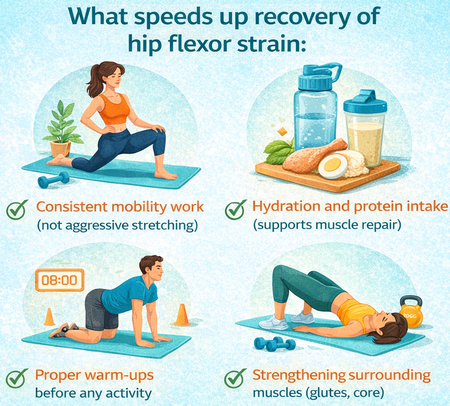
What speeds up recovery
Hip pain can be discomforting and frustrating as you face problems in doing daily tasks. Your daily activities like sitting, standing, exercise, sleeping becomes painful and it starts irritating you.
So, to get better in your recovery it’s important to follow some steps that will help you speed up your recovery like:
Avoid doing this while your recovery
- Pushing through pain
- Deep lunges or squats too early
- Skipping rehab exercises
- Sitting for long hours without breaks
How long does it take to recover?
- If the strain is mild it hardly takes 1- 3 weeks for recovery
- If the strain is more than it takes 3-6 weeks for recovery
- If the strain is severe then it might take more than 6 weeks to recover.
Recovery depends on how well you follow rehab.
When to see a doctor
Don’t ignore it if:
- Pain isn’t improving after a week
- You can’t walk without limping
- There’s bruising or swelling
A professional will examine the cause and will treat it accordingly.
Final thoughts
A Hip Flexor Strain can be a painful and bothersome experience but it heals faster when you rest early, move gradually, and strengthen properly. It’s not something which will cure overnight, you need to give proper care and time for that. Have your doctor look into your case if you face severe pain.
Frequently Asked Questions
Should I ice or heat hip flexor strain?
Use ice for the first 2–3 days to reduce swelling, then switch to heat to relax the muscle and aid healing.
Why has my hip flexor been hurting for months?
Your hip flexor may hurt for months due to ongoing strain, poor posture, lack of proper rest, or an untreated injury that hasn’t fully healed.
What can be mistaken for hip flexor pain?
Hip flexor pain can be mistaken for issues like groin strain, hernia, lower back pain, or hip joint problems.
Should you massage strained hip flexor?
Yes, you can gently massage a strained hip flexor after the initial pain and swelling reduce, as it can help relax the muscle and improve healing.
What is the best sleeping position for a hip strain?
The best sleeping position for a hip strain is on your back with a pillow under your knees or on your side with a pillow between your legs to reduce pressure on the hip.
References
- Mayo Clinic (Muscle strain symptoms and treatment guidelines)
- Cleveland Clinic (Hip flexor strain causes, recovery, and prevention)
- American Academy of Orthopaedic Surgeons (Muscle injuries and rehabilitation practices)
- National Health Service (Sprains and strains treatment recommendations)


Member discussion