

Jaw pain that feels deep, aching, or oddly spread across your face can be confusing. Sometimes it’s blamed on teeth, stress, or even sinus issues but the real culprit may be MJ trigger points, also known as masseter muscle trigger points. These trigger points are common, often overlooked, and very treatable once properly identified. Let’s break it down in simple terms.
This article explains anatomy, causes, symptoms, a clinical diagnostic approach, evidence-based treatments (self-care through advanced interventions), a step-by-step self-help protocol, prevention strategies, and when to seek urgent care.
What Are MJ Trigger Points?
MJ [Masseter Jaw] trigger points are tight, sensitive knots within the masseter muscle, one of the main muscles used for chewing. This muscle runs along the sides of your jaw and plays a major role in biting and clenching. When part of the muscle stays contracted for too long, blood flow decreases and waste products build up. This creates a trigger point, which can cause pain both at the site and in surrounding areas. the masseter lies on the side of the jaw between the zygomatic arch and the mandibular angle it has superficial and deep portions that attach to the mandible and help elevate the jaw during chewing.
Symptoms of MJ Trigger Points
MJ trigger points don’t always cause pain exactly where the knot is. This is what makes them tricky.
Common symptoms include:
- Jaw pain or tightness
- Facial pain near the cheeks
- Pain that spreads to the ear, temple, or teeth
- Headaches, especially around the temples
- Difficulty opening the mouth fully
- Pain while chewing or talking
- Sensation of ear fullness without infection
Some people even mistake MJ trigger point pain for:
- Toothache
- Sinus pressure
- Ear problems
Unlike normal muscle soreness, trigger point pain often:
- Feels deep and persistent
- Worsens with jaw movement
- Radiates to other parts of the face
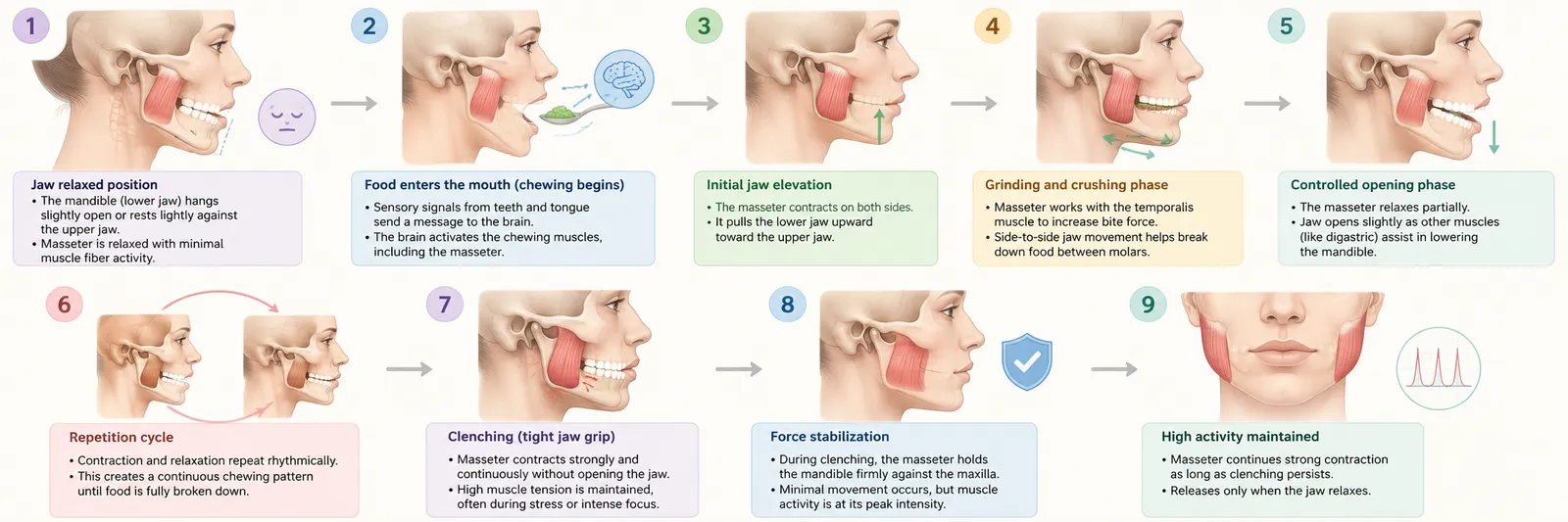
How the masseter works during chewing and clenching.
Every time you chew or clench your teeth, the masseter contracts to lift the jaw upward. It works in coordination with other muscles like the temporalis and pterygoids to control smooth and controlled biting.
Understanding its step-by-step function helps explain how chewing force is generated and regulated.
Step-by-step: How the masseter works during chewing and clenching
Neighboring muscles involved with the masseter
The masseter does not work alone it is part of a coordinated “chewing system” involving several neighboring muscles. These muscles share nerve pathways (mainly the trigeminal nerve), which is why pain or tension in one area can be felt in distant regions like the temple, ear, or teeth. This is called referred pain, and it’s especially common in jaw clenching, TMJ dysfunction, or chronic stress-related grinding.
Temporalis muscle
- Large, fan-shaped muscle on the side of the head (temple area)
- Helps lift and retract the jaw during chewing
- When overworked, it often causes temple headaches and pain around the side of the head
Medial pterygoid
- Located deep inside the jaw on the inner side of the mandible
- Works with the masseter to generate strong biting force
- Overactivity can cause deep jaw pain and discomfort near the throat or inner jaw
Lateral pterygoid
- Controls jaw opening and side-to-side movement
- Plays a key role in jaw positioning during chewing
- Dysfunction can contribute to clicking jaw, TMJ strain, and ear-region pain
Neck muscles (especially sternocleidomastoid and upper trapezius)
- Stabilize head posture during chewing and clenching
- Tightness here often develops alongside jaw tension
- Can refer pain to the base of the skull, behind the ear, and upper neck
Typical referred pain patterns
Temple pain
- Most commonly linked to the temporalis muscle
- Feels like tight pressure or tension headache
Ear pain or fullness
- Often caused by lateral pterygoid dysfunction or TMJ stress
- Jaw and ear share close nerve and structural connections
Tooth pain (without dental issues)
- Trigger points in the masseter or medial pterygoid
- Can feel like aching molars or generalized dental sensitivity
Jawline and cheek pain
- Directly associated with masseter overuse
- Common in clenching or grinding (bruxism)
Neck and occipital (back of head) pain
- Linked to sternocleidomastoid and upper trapezius tension
- Often worsens with prolonged jaw clenching or poor posture
How to Differentiate Trigger Points from Tooth, Sinus, and TMJ Joint Disease
| Condition | Key Source | Reproducible Pain on Palpation | Pattern of Radiation (Where Pain Spreads) | Typical Clues |
|---|---|---|---|---|
| Myofascial Trigger Points (Masseter / Temporalis) | Muscle (jaw or temple muscles) | Pain can be recreated by pressing specific tight muscle bands | Radiates to temple, ear, teeth, or jawline | Worsens with clenching, chewing, or stress; feels like deep aching or pressure |
| Tooth-Related Pain (Dental issue) | Tooth or gum (infection, cavity, pulp inflammation) | Pain reproduced by tapping the tooth or biting pressure | Usually localized to one tooth; may spread to jaw but stays focused | Sharp, throbbing pain; sensitivity to hot/cold/sweets; visible dental issue often present |
| Sinus-Related Pain | Maxillary sinus (cheek and upper jaw region) | Pressure over cheek/sinus area may increase discomfort | Radiates to cheeks, upper teeth, forehead | Worse when bending forward; nasal congestion, cold symptoms present |
| TMJ Joint Disease (Temporomandibular Joint Dysfunction) | Jaw joint (TMJ capsule and disc) | Pain reproduced by jaw movement (opening, closing, side shift) | Radiates to ear, temple, jaw joint region | Clicking, popping, jaw locking, pain during mouth opening or chewing |
Common Causes & Risk Factors of MJ Trigger Points
Several everyday habits and conditions can lead to trigger points in the masseter muscle.
Bruxism (awake and sleep clenching)
- Involuntary grinding or clenching of teeth during sleep or daytime stress.
- Leads to overuse of the masseter and temporalis muscles, causing tightness, fatigue, and trigger points.
Stress and anxiety
- Emotional stress often triggers unconscious jaw clenching.
- Sustained muscle tension increases risk of pain, stiffness, and headaches.
Poor posture (forward head posture)
- Head jutting forward increases strain on jaw and neck muscles.
- Forces the masseter to work harder to stabilize the jaw, contributing to chronic tension.
Chewing habits (gum chewing or one-sided chewing)
- Excessive chewing of gum overloads jaw muscles.
- Chewing predominantly on one side creates muscle imbalance and localized overuse.
Recent dental work
- Long dental procedures keep the jaw open for extended periods.
- This can fatigue or strain the masseter and surrounding muscles.
Jaw trauma or injury
- Direct impact, accidents, or whiplash can disrupt normal jaw mechanics.
- May lead to muscle guarding, inflammation, and trigger point formation.
Sleep disorders (sleep apnea)
- Often associated with nighttime bruxism.
- Repeated micro-arousals can increase jaw muscle activity during sleep.
Inflammatory conditions (TMJ dysfunction, arthritis)
- Joint or surrounding tissue inflammation alters normal jaw movement.
- Causes compensatory overactivation of the masseter and related muscles.
Dental misalignment (malocclusion)
- Poor bite alignment forces uneven muscle load during chewing.
- Over time, this leads to chronic muscle overuse and asymmetry.


Consult a dental surgeon
How Are MJ Trigger Points Diagnosed?
There’s no scan or blood test for trigger points. Diagnosis is usually based on:
- Medical history
- Jaw movement assessment
- Palpation (manual examination of the muscle)
Treatment Options for MJ Trigger Points
The good news? Most MJ trigger points respond well to conservative, non-invasive treatment.
1. Manual Therapy
- Trigger point release
- Myofascial massage
- Physiotherapy techniques
These help relax the muscle and restore blood flow.
2. Heat Therapy
Warm compresses improve circulation and reduce muscle tension when used regularly.
3. Stress Management
Since stress plays a major role, to reduce such symptoms you can do techniques like:
- Deep breathing
- Mindfulness
- Jaw awareness exercises
4. Night Guards or Splints
For people who grind or clench at night, dental appliances protect teeth and reduce muscle overuse.
5. Medications
Short term use of muscle relaxants and pain relievers may help during flare-ups, under medical guidance.
Can MJ Trigger Points Be Prevented?
While not always avoidable, you can reduce the risk by:
- Avoiding excessive gum chewing
- Maintaining good posture
- Managing stress
- Being mindful of jaw clenching
- Taking breaks from screens
Early attention to jaw discomfort can prevent chronic pain.
Final Thoughts
MJ trigger points are a muscle problem which if not treated on time can result in chronic pain. They’re common, especially in people under stress or those who clench their jaw unconsciously.
If you’ve been living with unexplained facial or jaw pain, don’t ignore it or assume it’s just stress. With the right approach, masseter trigger points can be treated on time without any surgery.
References
- Cleveland Clinic. Myofascial Pain Syndrome and Trigger Points. – Cleveland Clinic
- StatPearls. Myofascial Trigger Points. NCBI Bookshelf. – StatPearls / NCBI Bookshelf
Frequently asked questions
Are MJ trigger points the same as TMJ?
No. Trigger points affect muscles, while TMJ involves the jaw joint. They can occur together.
Can trigger points cause tooth pain?
Yes. Referred pain from the masseter can feel like a toothache.
Do jaw exercises help trigger points?
Gentle stretching may help, but aggressive exercises can worsen symptoms.
How long does recovery take?
With proper treatment, many people improve within weeks.